
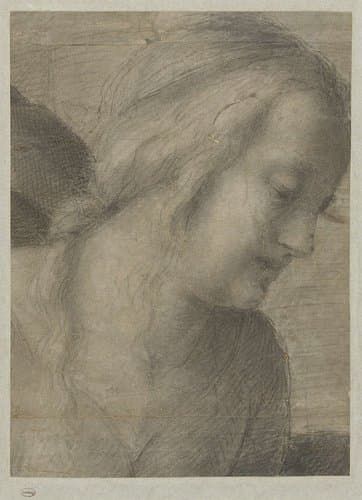
Hoofd van Maria, in een Aanbidding
1518 - 1523
Medium
paper
Dimensions
239; 321
Rights
Public Domain
About this artwork
zwart krijt op grijsbruin papier
Art Historical Context
Andrea del Sarto's *Hoofd van Maria, in een Aanbidding* (Head of Mary, in an Adoration), created between 1518 and 1523, is a delicate preparatory drawing on gray-brown paper, measuring 321 mm high by 239 mm wide. Rendered in black chalk—a favored medium for its soft, expressive qualities—this intimate study captures the serene face of the Virgin Mary, likely intended for a larger adoration scene. Del Sarto, a leading Florentine painter of the High Renaissance, was renowned for his masterful draftsmanship, blending the refined grace of Raphael with Leonardo da Vinci's sfumato-like subtlety. During the early 16th century, Renaissance artists like del Sarto elevated drawings from mere sketches to independent works of art, often using toned paper to enhance modeling through highlights and shadows. The gray-brown ground here provides a subtle mid-tone, allowing the black chalk to sculpt Mary's gentle features with remarkable tenderness and realism. This technique reflects the period's emphasis on anatomical precision and emotional depth, hallmarks of Florentine humanism. Though small in scale, this drawing exemplifies del Sarto's pivotal role in bridging High Renaissance ideals with emerging Mannerism. Visitors will appreciate its luminous quality, evoking the spiritual intimacy of Mary's gaze amid adoration— a testament to why del Sarto earned the nickname "the perfect painter."
About the Artist
Andrea del Sarto · 1486–1530
Andrea was the leading painter in Florence in the early 16th century. He was influenced by Leonardo da Vinci, Fra Bartolommeo, Michelangelo and Raphael. He developed his own version of the classical style of the High Renaissance, anticipating some qualities of Mannerism. He is noted for paintings of religious themes and portraits.