
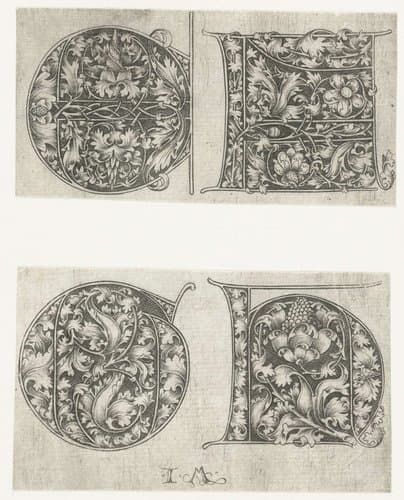
Hoofdletters E, F, G, en H
1455 - 1503
Medium
engraving
Dimensions
113; 114; 59; 66
Rights
Public Domain
About this artwork
blad: hoogte 59 mm (strook met hoofdletters E en F) x breedte 114 mm (strook met hoofdletters E en F) x hoogte 66 mm (strook met hoofdletters G en H) x breedte 113 mm (strook met hoofdletters G en H)
Art Historical Context
Israhel van Meckenem, a prolific German engraver active in the late fifteenth century, created this delicate print featuring the capital letters E, F, G, and H. Working during the early days of printmaking in Europe, van Meckenem produced hundreds of engravings that helped popularize the medium as both an art form and a means of sharing designs. His works often served practical purposes, providing models for other artists, craftsmen, or scribes. Executed in engraving on small strips measuring roughly 59–66 mm in height, the piece showcases the precision possible with the burin technique. The compact format suggests these letterforms may have been intended as ornamental borders or instructional examples rather than standalone images. Such alphabet prints reflect the growing demand for standardized, reproducible designs amid the transition from handwritten manuscripts to printed books. As one of the first artists to sign many of his engravings, van Meckenem helped elevate printmaking’s status. This modest yet finely detailed work offers a glimpse into how Renaissance artisans used the new technology to preserve and circulate letterforms and decorative motifs across workshops.
About the Artist
Israhel van Meckenem · 1435–1503
Israhel van Meckenem (c. 1445–1503), also known as Israhel van Meckenem the Younger, was a pioneering German engraver and goldsmith based in Bocholt, near the Dutch border, renowned as the most prolific printmaker of the fifteenth century. Born into a family possibly of Dutch origin, he was the son of Israhel van Meckenem the Elder, a goldsmith who settled in Bocholt in 1457. He trained initially ...