
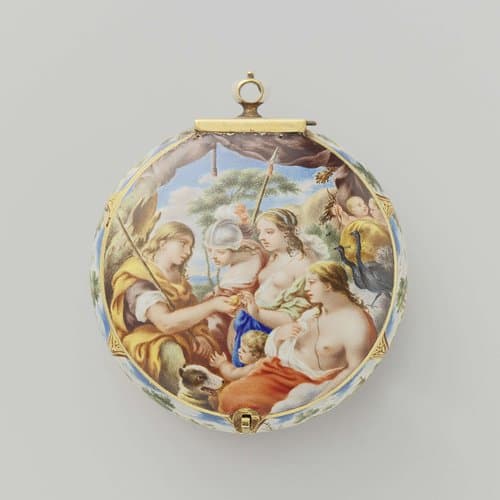
Horloge met klassieke liefdesverhalen, het oordeel van Paris en het afscheid van Dido en Aeneas
c. 1640 - c. 1660
Medium
jewellery
Dimensions
6
Rights
Public Domain
About this artwork
diameter 6 cm
Art Historical Context
Nestled in the intricate world of 17th-century European craftsmanship, *Horloge met klassiekedesverhalen, hetordeel van Paris en hetscheid van Dido enas* by Mathias Rieppolt (c. 1640–1660) is a exquisite jewel-like clock, measuring just 6 cm in. Crafted as wearable jewellery, this miniature time exemplifies the era's fusion of functionality and artistry, personal adornments doubled as storytelling canvases. Rieppolt, a skilled artisan likely working in the Low Countries or German-speaking regions, captured classical mythology in a compact form, blending horology with narrative enamel work—a technique prized for its luminous detail on precious metals. The clock's enamelled scenes depict two timeless tales of love and fate: the Judgment of Paris, where the Trojan prince awards a golden apple to Aphrodite, sparking the Trojan War; and the poignant farewell of Dido and Aeneas, drawn from Virgil's *Aeneid*, symbolizing doomed passion as the hero abandons Carthage's queen. These motifs, popular in Baroque art, reflected the period's fascination with antiquity, evoking themes of desire, destiny, and divine intervention amid Europe's cultural Renaissance. As a rare surviving example of mid-17th-century micro-artistry, this piece highlights the technical virtuosity required to render epic narratives on such a diminutive scale. Worn as a pendant or brooch, it would have served as both a fashionable accessory and a conversation starter, inviting admirers to ponder the enduring drama of classical lore through the steady tick of time.