
Horn
Unknown Artist
late 19th century
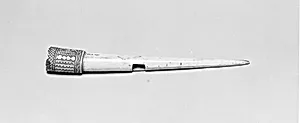
Medium
Ivory
Dimensions
L. 29.8 cm (11-3/4 in.)
Classification
Aerophone-Lip Vibrated-horn
Culture
Tanzanian (Zanzibar)
Department
Musical Instruments
Museum
Metropolitan Museum of Art, New York, NY
Credit
The Crosby Brown Collection of Musical Instruments, 1889
Accession Number
89.4.457
Rights
Public Domain
Art Historical Context
This elegant ivory horn, crafted by an unknown artist in late19th-century Zanzibar Tanzania, exemplifies the region's masterful tradition of carving precious materials. Measuring 29.8 cm in length, it belongs to the aerophone family—specifically a lip-vibrated horn—where the player buzzes their lips into the mouthpiece to produce deep, resonant tones. The smooth, polished ivory surface highlights the artisan's skill in shaping and finishing the natural tusk, a technique prized in East African coastal cultures where ivory was both a trade commodity and a symbol of prestige. Zanzibar, a vibrant Swahili hub under Omani influence during this era, thrived on Indian Ocean commerce, including ivory from inland Africa. Such horns likely served ceremonial or signaling roles in royal courts, festivals, or maritime processions, blending African, Arab, and Indian musical traditions. Their portability made them ideal for communal gatherings, evoking the island's multicultural pulse. Acquired as part of The Crosby Brown Collection of Musical Instruments in 1889, this piece now resides in the Metropolitan Museum of Art's Department of Musical Instruments. It invites visitors to ponder the artistry behind everyday sounds, bridging Tanzania's past with global heritage.