
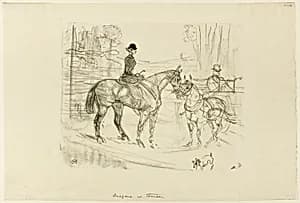
Horsewoman and Cart
Medium
Lithograph on cream laid paper
Dimensions
Image: 23.4 × 29 cm (9 1/4 × 11 7/16 in.); Sheet: 31.4 × 46.7 cm (12 3/8 × 18 7/16 in.)
Classification
lithograph
Department
Prints and Drawings
Museum
Art Institute of Chicago
Accession Number
55816
Rights
Public Domain
Art Historical Context
Henri de Toulouse-Lautrec *Horsewoman and Cart*1899) captures the vibrant energy of fin-de-siècle Paris through the artist's masterful lithography. A leading Post-Impressionist printmaker, Toulouse-Laut was renowned for his bold depictions of urban life, from Montmartre cabarets to everyday scenes. Created late in his short career—cut short by illness at age 36—this lithograph on cream laid paper showcases a poised horsewoman guiding a cart, evoking the bustling streets and equestrian culture of the Belle Époque. Lithography was Toulouse-Lautrec's signature medium, allowing him to blend painterly effects with the reproducibility of posters. He drew directly on the lithographic stone, achieving rich textures and subtle tones on the laid paper's textured surface (31.4 × 46.7 cm sheet). This technique democratized art, making high-quality prints affordable and transforming advertising into fine art—Lautrec produced over 30 iconic posters. Housed in the Art Institute of Chicago's Prints and Drawings Department, this work highlights Toulouse-Lautrec's eye for the dynamic and the ordinary, bridging elite art with popular culture. A testament to his innovative spirit, it invites visitors to glimpse the rhythm of 19th-century Parisian life.
About the Artist
Henri de Toulouse-Lautrec · 1864–1901
Henri Marie Raymond de Toulouse-Lautrec-Montfa (1864-1901) was a French Post-Impressionist painter, printmaker, and illustrator whose innovative poster designs revolutionized graphic art and advertising in late 19th-century Paris. Born into an aristocratic family at Albi in southern France, Toulouse-Lautrec's privileged lineage traced back to the Counts of Toulouse and extended uninterrupted to th...