
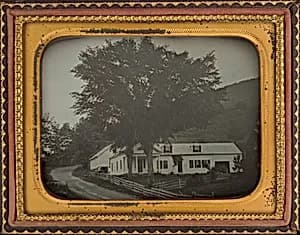
House on a Hillside
c. 1850
Medium
daguerreotype
Dimensions
image (visible): 6.6 × 9 cm (2 5/8 × 3 9/16 in.) mat: 7.6 × 10.2 cm (3 × 4 in.) case (closed): 9.4 × 12 × 1.7 cm (3 11/16 × 4 3/4 × 11/16 in.)
Classification
Photograph
Department
CPH
Museum
National Gallery of Art, Washington, D.C.
Credit
Pepita Milmore Memorial Fund
Accession Number
2015.57.2
Rights
Public Domain
Art Historical Context
Step into the dawn of photography with *House on a Hillside a captivating daguerreotype from around 1850, created by an anonymous American artist. This petite image (just 6.6 × 9 cm) captures a modest dwelling perched on a gentle slope, framed by the natural contours of the American landscape. Encased in a protective 9.4 × 12 cm leather or thermoplastic case—typical for the era—it offers an intimate glimpse into mid-19th-century rural, where homes like this dotted the countryside amid westward expansion and agrarian ideals. As one of the earliest photographic mediums, the daguerreotype revolutionized image-making after its 1839 debut. Polished silver-plated copper sheets were exposed in a camera obscura, then developed with mercury vapor and fixed with gold chloride, yielding a one-of-a-kind, mirror-like positive image that sparkles under light. In America, these treasures were prized for portraits but also ventured into landscapes and architecture, documenting a vanishing vernacular world before the Civil War. This example, acquired through the Pepita Milmore Memorial Fund for the National Gallery of Art's photography collection, highlights photography's role in preserving everyday scenes with unprecedented detail and realism. Though small, *House on a Hillside* whispers stories of resilience and simplicity, inviting us to ponder the lives within its walls. A true pioneer artifact, it bridges art and history in the CPH department.
About the Artist
American 19th Century · 1800–1900
The artist cataloged as "American, 19th Century" represents a collective of unidentified painters active in the United States during the nineteenth century, with 380 known artworks preserved in this virtual museum's collection. These works span a diverse array of genres typical of the era, including portraits, landscapes, still lifes, and genre scenes, reflecting the burgeoning artistic output of ...