
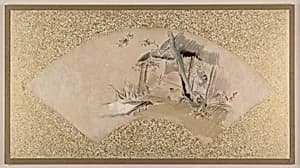
House with Woman and Baby
late 19th century
Medium
Fan painting mounted as album leaf; tempera on paper
Dimensions
Overall: 13 x 23 5/8 in. (33 x 60 cm) Image: 7 1/2 x 20 1/2 in. (19.1 x 52.1 cm)
Classification
Paintings
Culture & Period
Japan · Meiji period (1868–1912)
Department
Asian Art
Museum
Metropolitan Museum of Art, New York, NY
Credit
Purchase, Gifts, Bequests, and Funds from various donors, by exchange, 1952
Accession Number
52.160.6k
Rights
Public Domain
Tags
Art Historical Context
Shibata Zeshin's *House with Woman and Baby created in the late 19 century during Japan's Meiji period (186–1912), captures a serene domestic moment amid a time of profound transformation. As the nation modernized and opened to Western influences, artists like Zeshin—owned for his mastery of lacquer and painting—bridged traditional Japanese aesthetics with innovative techniques. This intimate scene of a woman and baby within a house reflects everyday life, evoking the quiet beauty of family and home in a rapidly changing society. Painted in tempera on paper, the work originated as a fan painting, a popular format for portable, personal art in Japan, later mounted as an album leaf for preservation and display. Measuring about 7½ x 20½ inches for the image, its elongated shape suits the fan's graceful curve, allowing Zeshin to showcase delicate brushwork and vibrant colors. Tempera, with its opaque pigments, lent a luminous quality, highlighting the architectural details of the house and tender figures. Housed in the Metropolitan Museum of Art's Asian Art Department, this piece exemplifies Meiji-era painting's cultural role: preserving intimate, human-centered narratives amid modernization. Visitors will appreciate its warm portrayal of women and children, offering a window into Japan's artistic heritage.
About the Artist
Shibata Zeshin · 1807–1891
Japanese, 1807–1891