
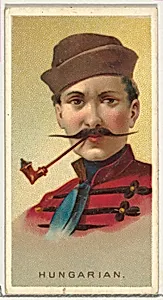
Hungarian, from World's Smokers series (N33) for Allen & Ginter Cigarettes
1888
Medium
Commercial color lithograph
Dimensions
Sheet: 2 3/4 x 1 1/2 in. (7 x 3.8 cm)
Classification
Prints|Ephemera
Department
Drawings and Prints
Museum
Metropolitan Museum of Art, New York, NY
Credit
The Jefferson R. Burdick Collection, Gift of Jefferson R. Burdick
Accession Number
63.350.202.33.14
Rights
Public Domain
Tags
Art Historical Context
This charming 1888 commercial color lithograph, titled *Hungarian* from Allen & Ginter’s “World’s Smokers” series (N33), offers a delightful glimpse into late nineteenth-century advertising and global curiosity. Produced as a small collectible card—measuring just 2¾ by 1½ inches—to be included in packs of cigarettes, the print depicts a Hungarian man enjoying a smoke. Allen & Ginter, a leading American tobacco company, commissioned these colorful trade cards to appeal to a growing market of smokers interested in international customs. The card belongs to a broader series illustrating men from various nations engaged in the act of smoking, reflecting the era’s fascination with cultural diversity alongside the rapid rise of cigarette consumption. Color lithography made such vibrant, affordable images possible on a mass scale, transforming everyday ephemera into miniature works of art. Today, this piece forms part of the Metropolitan Museum’s Jefferson R. Burdick Collection, where these once-disposable cards are preserved for their insight into both printmaking techniques and social history.
About the Artist
Allen & Ginter
Allen & Ginter, the pioneering American tobacco firm based in Richmond, Virginia, emerged around 1880 from the partnership of John F. Allen and Lewis Ginter, evolving from Allen's earlier John F. Allen & Company. Allen retired in 1882, succeeded by John Pope, yet the brand endured under Ginter's leadership, employing over 1,100 workers—mostly women—for hand-rolled cigarettes by 1886. Ginter, a Dut...