
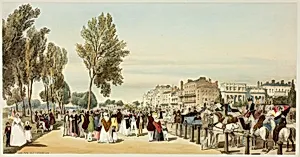
Hyde Park Near Crosvenor Gate, plate sixteen from Original Views of London as It Is
Medium
Hand-colored lithograph on paper
Dimensions
24.3 × 47 cm (9 5/8 × 18 9/16 in.)
Classification
lithograph
Department
Prints and Drawings
Museum
Art Institute of Chicago
Accession Number
131155
Rights
Public Domain
Art Historical Context
Thomas Shotter Boys created this hand-colored lithograph in 1842 as plate sixteen in his celebrated series *Original Views of London as It Is*. The image captures a serene stretch of Hyde Park near Grosvenor Gate, offering viewers a glimpse of early Victorian London’s most fashionable public space. At a time when the city was rapidly expanding, Boys chose to document its parks, streets, and architecture with remarkable fidelity, preserving a record of London just as the industrial age began to reshape daily life. The medium itself reflects the artistic innovations of the period. Lithography, a relatively new printing process, allowed for precise detail and wide distribution, while the delicate hand-coloring adds warmth and individuality to each impression. Measuring just under ten by nineteen inches, the panoramic format invites the eye to wander across the park’s open lawns and pathways, evoking the leisurely pace of 19th-century promenades. Today, this print in the Art Institute of Chicago’s collection stands as both an artistic achievement and a valuable historical document. Boys’ sensitive rendering of light, atmosphere, and urban greenery continues to charm visitors, reminding us how artists of his era used new reproductive techniques to celebrate the character of a changing city.
About the Artist
Thomas Shotter Boys · 1803–1874
Thomas Shotter Boys was born on 2 January 1803 in Pentonville, London, and received his first professional training as an apprentice to the engraver George Cooke. When his apprenticeship concluded he crossed the Channel to Paris, a move that would transform his artistic direction entirely. There he encountered Richard Parkes Bonington, the brilliant English watercolourist whose fresh, luminous ren...