
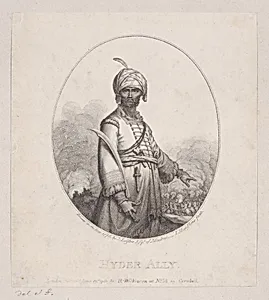
Hyder Ally
Medium
Stipple engraving
Dimensions
sheet: 8 1/16 x 7 3/16 in. (20.4 x 18.2 cm) image: 5 15/16 x 4 7/8 in. (15.1 x 12.4 cm)
Classification
Prints
Department
Drawings and Prints
Museum
Metropolitan Museum of Art, New York, NY
Credit
Rogers Fund, 1962
Accession Number
62.602.294
Rights
Public Domain
Tags
Art Historical Context
"Hyder Ally," a stipple engraving from June 13, 1781, captures the formidable presence of Haidar Ali (also known as Hyder Ali the influential 18th-century ruler of Kingdom of Mysore in southern India. Created after a drawing by J. Leister, Esq. of Madras, associated with publishers Robert Wilkinson and caricaturist James Gillray this print measures a modest 8 x 7 inches on its sheet. Housed in the Metropolitan Museum of Art's Drawings and Prints department (Rogers Fund, 1962), it depicts men with swords, evoking the martial prowess of its subject. Haidar Ali rose to power amid colonial tensions, leading Mysore against British forces in the Anglo-Mysore Wars, particularly the Second War (1780–1784). Published at the height of these conflicts, the print reflects British fascination—and wariness—with this strategic leader who challenged East India Company dominance through innovative tactics and alliances. Stipple engraving, the medium here, uses fine dots to create subtle tones and textures, ideal for detailed portraits and reproductions from drawings. This technique lent a refined, almost painterly quality to affordable prints, making images of distant figures like Haidar Ali accessible to European audiences. A window into 18th-century imperialism and print culture, it invites us to ponder the human stories behind global power struggles.
About the Artist
J. Leister, Esq. of Madras|Robert Wilkinson|Haidar Ali|James Gillray (British|British|Indian|British) · 1750 |1758 |1722 |1756 –1850 |1825 |1782 |1815
British, active 1776|British, active 1758–1825|Indian, Budikote, Mysore 1722–1782 Chittoor|British, London 1756–1815 London