
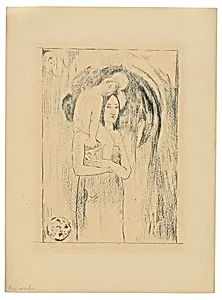
Ia orana Maria (Hail Mary)
1894/95, published Mar. 1895
Medium
Transfer zincograph on coarse-grained transfer paper, in dark-blue ink on cream wove paper (an imitation Japanese vellum)
Dimensions
Image: 25.7 × 18.6 cm (10 1/8 × 7 3/8 in.); Sheet: 38.1 × 28.1 cm (15 × 11 1/8 in.)
Classification
zincograph
Department
Prints and Drawings
Museum
Art Institute of Chicago
Accession Number
80861
Rights
Public Domain
Art Historical Context
**Ia Orana Maria (Hail)**, created by Paul Gauguin 1894/95 and published in March 1895, captures the Post-Impressionist master's fascination with Tahiti. Fresh from his first voyage to the South Pacific (1891–93), Gauguin infused Christian iconography—the Annunciation—with Polynesian elements. The title, Tahitian for "Hail Mary," greets the Virgin Mary in a vibrant, exotic setting, reflecting his "primitivist" vision that blended European symbolism with island culture to critique Western modernity. This zincograph, a lithographic print on zinc plates, showcases Gauguin's innovative printmaking. He drew on coarse-grained transfer paper, transferring the image for printing in deep blue ink on cream wove paper mimicking Japanese vellum—a nod to Japonisme. Measuring just 25.7 × 18.6 cm (image), its intimate scale suited the Noa Noa album, blending bold contours and flattened forms typical of his style. Housed in the Art Institute of Chicago's Prints and Drawings department, this work highlights Gauguin's bridge between painting and print, making his Tahitian reverie accessible. It invites visitors to ponder cultural fusion and the artist's quest for an earthly paradise.
About the Artist
Paul Gauguin · 1848–1903
Paul Gauguin (1848-1903) was a French Post-Impressionist painter whose bold experiments with color, form, and subject matter made him one of the most influential figures in the transition from 19th-century art to modernism. His rejection of European civilization for the perceived authenticity of 'primitive' cultures established an archetype of artistic exile that continues to resonate. Gauguin's ...