
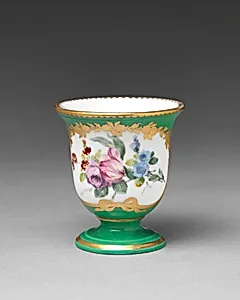
Ice cream cup (tasse à glace) (one of thirty-one) (part of a service)
Medium
Soft-paste porcelain
Dimensions
confirmed: 2 5/8 × 2 7/8 × 2 5/16 in. (6.7 × 7.3 × 5.9 cm)
Classification
Ceramics-Porcelain
Culture
French, Sèvres
Department
European Sculpture and Decorative Arts
Museum
Metropolitan Museum of Art, New York, NY
Credit
Bequest of Emma T. Gary, 1934
Accession Number
37.20.53
Rights
Public Domain
Tags
Art Historical Context
This delicate ice cream cup, or *tasse à glace*, by the renowned Sèvres Manuf in 1771, exemplifies the pinnacle of 18th-century French porcelain. Produced at the royal factory near Versailles, it forms part of an elegant service of thirty-one cups, designed for serving luxurious frozen desserts that were all the rage among the French aristocracy during Louis XV's reign. Measuring just 2⅝ × 2⅞ × 2¼ inches, its petite scale highlights the precision required for such intimate tableware. Sèvres specialized in soft-paste porcelain, a prized material blending clay, glass frit, and white lead for a creamy translucency and subtle glow that hard-paste rivals couldn't match until later. Adorned with floral motifs—evident in its decorative tags—the cup reflects the Rococo style's love for nature-inspired elegance, often hand-painted by master gilders and enamelers. These pieces were status symbols, commissioned for royal banquets and exported to Europe's elite. Bequeathed to the Metropolitan Museum of Art in 1934 by Emma T. Gary, this cup invites us to savor the opulence of Versailles dining, where porcelain like this bridged art and indulgence in everyday luxury.
About the Artist
Sèvres Manufactory · 1740–present
The Sèvres Manufactory, one of Europe's premier porcelain producers, was established in 1740 as the Manufacture de Vincennes under the patronage of Queen Marie Leszczyńska, who sought to rival Meissen and Chantilly porcelains with French soft-paste innovations. Initially a private venture, it relocated to Sèvres in 1756 in a purpose-built facility designed by architect Laurent Lindet near Madame d...