
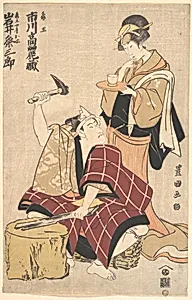
Ichikawa Komazō III in the Role of Kameō with Iwai Kumesaburō in the Role of Kameō's Wife, Oyasu, from the Play Shunkan futatsu omokage
1798–99
Medium
Woodblock print; ink and color on paper
Dimensions
H. 15 in. (38.1 cm); W. 9 5/8 in. (24.4 cm)
Classification
Prints
Culture & Period
Japan · Edo period (1615–1868)
Department
Asian Art
Museum
Metropolitan Museum of Art, New York, NY
Credit
Rogers Fund, 1919
Accession Number
JP1119
Rights
Public Domain
Tags
Art Historical Context
This vibrant woodblock print by Utagawa Toyok I, created around 1798–99 Japan's Edo period (1615–1868), captures two celebrated kabuki actors: Ich Komazō III as the character Kameō and Iwai Kumesaburō III as his wife, Oyasu, from the play *Shunkanatsu omokage*. Toyokuni, a master of the ukiyo-e ("pictures of the floating world") school, specialized in yakusha-e—portraits of theater performers—that brought the drama of kabuki stages to everyday viewers. These affordable prints democratized art, turning actors into cultural icons. Measuring about 15 by 9½ inches, the work showcases Toyokuni's skill in dynamic poses, expressive faces, and rich colors achieved through the meticulous woodblock process: carvers and printers layered inks on mulberry paper for vivid hues and intricate details. Kabuki, with its all-male casts including onnagata (men playing women like Oyasu), was a booming entertainment form in Edo (modern Tokyo), reflecting societal fascination with beauty, emotion, and performance. Held in the Metropolitan Museum of Art's Asian Art collection (Rogers Fund, 1919), this print offers a window into 18th-century Japanese urban life, preserving fleeting theatrical moments for posterity and highlighting ukiyo-e's role in shaping global perceptions of Japanese art.
About the Artist
Utagawa Toyokuni I · 1777–1835
Japanese, 1777–1835