
Ile de Fîleh (Philæ), Vu Générale Prise du Nord-Ouest au Point A
1851–52
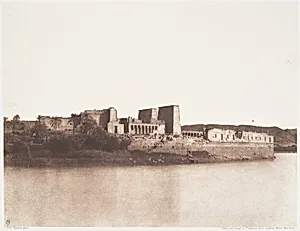
Medium
Salted paper print from paper negative
Dimensions
Image: 23.9 x 31.2 cm (9 7/16 x 12 5/16 in.) Mount: 39.8 x 51.6 cm (15 11/16 x 20 5/16 in.)
Classification
Photographs
Department
Photographs
Museum
Metropolitan Museum of Art, New York, NY
Credit
Gilman Collection, Gift of The Howard Gilman Foundation, 2005
Accession Number
2005.100.942
Rights
Public Domain
Tags
Art Historical Context
Félix Teynard's *Ile de Fîleh (Philæ), Vuérale Prise du Norduest au Point A*1851–52) offers a captivating early photographic vista of Philae, a Nile River island famed for its ancient Egyptian temples dedicated to Isis. This salted paper print from a paper negative captures the site's architectural grandeur and lush landscape from a northwest vantage, blending monumental ruins with the river's serene flow. Teynard, a photographer and draftsman, created this during his expedition to Egypt and Nubia, at a time when Western artists and scholars flocked to document pharaonic wonders amid rising archaeological fervor. As one of the pioneering calotype images—using William Henry Fox Talbot's process of paper negatives printed on salted paper—this 23.9 x 31.2 cm work exemplifies mid-19th-century photography's technical leap. The medium's subtle tonal range and fine detail preserved fleeting views of sites now altered by time and the Aswan Dam. Housed in the Metropolitan Museum of Art's Gilman Collection, it highlights photography's role in bridging art, science, and exploration, immortalizing Egypt's architectural legacy for global audiences. (198 words)
About the Artist
Félix Teynard · 1817–1892
**Félix Teynard (1817–1892)** was a pioneering French photographer whose work captured the ancient wonders of Egypt and Nubia with unprecedented precision and artistry. Born on January 14, 1817, in Saint-Flour, he trained as a civil engineer in Grenoble, a hub of Egyptology that likely sparked his fascination with ancient architecture. Little is documented about his early life or formal photograph...