
Illuminated Leaf
Unknown Artist
16th century
Medium
Ink, opaque watercolor, and gold on paper
Dimensions
H. 7 1/2 in. (19.1 cm) W. 3 5/8in. (9.2 cm)
Classification
Codices
Department
Islamic Art
Museum
Metropolitan Museum of Art, New York, NY
Credit
Purchase, Joseph Pulitzer Bequest, 1952
Accession Number
52.20.8
Rights
Public Domain
Tags
Art Historical Context
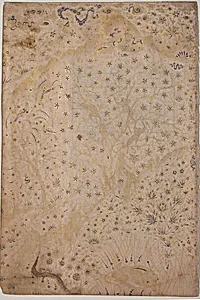
This exquisite *Illuminated Leaf* from the 16th century offers a glimpse into the splendor of Islamic manuscript traditions. Housed in the Metropolitan Museum of Art's Department of Islamic Art, this small page—measuring just 7½ by 3⅝ inches—was once part of a codex, a bound book format that revolutionized Islamic bookmaking from the early medieval period onward. Crafted by an unknown artist, it features vibrant depictions of lions, birds, and monkeys, likely rendered as marginal decorations or illustrations in a larger scholarly or literary work. The medium—ink, opaque watercolor, and gold on paper—exemplifies the opulent techniques of Islamic illumination. Gold leaf adds a shimmering, jewel-like quality, while opaque watercolors (often gouache) create bold, saturated colors that endure centuries. These animal motifs, common in Persian and Ottoman manuscripts, may draw from natural history treatises or fables, symbolizing power (lions), freedom (birds), and playfulness (monkeys), blending observation with imagination. Acquired in 1952 through the Joseph Pulitzer Bequest, this leaf highlights the artistic patronage of the Islamic world, where such pages adorned religious texts, poetry, and sciences. Visitors will appreciate its intricate detail, inviting closer inspection to uncover the lively menagerie frozen in time.