
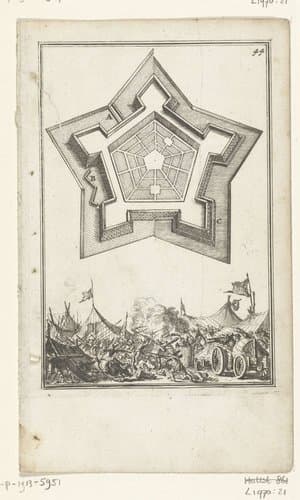
Illustratie voor 'Den Arbeid van Mars' van Allain Manesson Mallet
1672
Medium
etching
Dimensions
185; 111
Rights
Public Domain
About this artwork
blad: hoogte 185 mm x breedte 111 mm
Art Historical Context
This delicate etching by Romeyn de Hooghe created in 1672, serves as an illustration for *Den Arbeid van* by Alain Manesson Mallet, treatise on military engineering and the "works of Mars," the Roman god of war Measuring just 185 mm high by 111 mm wide, the compact sheet exemplifies the precision of 17th-century Dutch printmaking, designed for inclusion in scholarly books that popularized fortifications, sieges, and strategic architecture during an era of intense European conflicts, including the Third Anglo-Dutch War. De Hooghe, a versatile Baroque artist renowned for his intricate engravings and satirical works, masterfully employed etching techniques—biting acid into a metal plate—to capture fine details with dynamic lines and textures. This medium was ideal for disseminating complex technical illustrations to a wide audience, bridging art and science in the Dutch Golden Age, when innovation in publishing flourished alongside military prowess. As a snapshot of 1670s intellectual culture, this piece highlights how visual art illuminated the era's obsessions with warfare and engineering, offering visitors a window into the blend of artistry and utility that defined Baroque-era knowledge production.
About the Artist
Romeyn de Hooghe · 1645–1708
Romeyn de Hooghe (1645-1708) was a Dutch Baroque engraver, draughtsman, and political satirist who became the most prolific and versatile graphic artist of the Dutch Republic in the late seventeenth century. Born in Amsterdam, he rose to become one of early modern Europe's most important printmakers and a pioneering master of political satire. De Hooghe's significance extends far beyond his techn...