
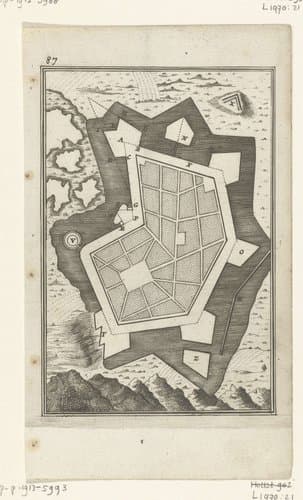
Illustratie voor 'Den Arbeid van Mars' van Allain Manesson Mallet
1672
Medium
etching
Dimensions
108; 185
Rights
Public Domain
About this artwork
blad: hoogte 185 mm x breedte 108 mm
Art Historical Context
This delicate etching, titled *Illustratie voor 'Den Arbeid Mars' van Allainesson Mallet*, was created by the prolific Dutch artist Romeyn de Hooghe 1672. Measuring just 185 mm high by 108 mm wide, it served as a book illustration for Alain Manesson Mallet's treatise on military engineering, *Les Travaux de Mars* (The Works of Mars which explored fortifications, sieges, and the god of war's strategic "labors." De Hooghe, a master of the Dutch Golden Age, was renowned for his intricate etchings that blended Baroque flair with technical precision, often illuminating scholarly texts on history, mythology, and science. Etching, de Hooghe's favored medium here, allowed for sharp lines and rich tonal contrasts, ideal for capturing the geometric rigor of bastions, ramparts, and battle scenes in miniature scale. Produced amid the tumultuous "Disaster Year" of 1672—when the Dutch Republic faced invasion by France, England, and others—this image reflects the era's obsession with defensive architecture amid Franco-Dutch wars. As a window into 17th-century military culture, the artwork highlights how art intersected with engineering, making complex Vauban-style fortification designs accessible to readers. De Hooghe's vivid style not only educated but also dramatized war's mechanics, underscoring the blend of intellect and conflict in Europe's Age of Absolutism.
About the Artist
Romeyn de Hooghe · 1645–1708
Romeyn de Hooghe (1645-1708) was a Dutch Baroque engraver, draughtsman, and political satirist who became the most prolific and versatile graphic artist of the Dutch Republic in the late seventeenth century. Born in Amsterdam, he rose to become one of early modern Europe's most important printmakers and a pioneering master of political satire. De Hooghe's significance extends far beyond his techn...