
Illustratie voor 'Den Arbeid van Mars' van Allain Manesson Mallet
1672
Medium
etching
Dimensions
111; 185
Rights
Public Domain
About this artwork
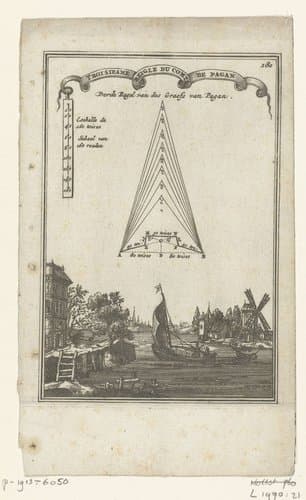
Wiskundige figuur. Daaronder een gezicht op een molen en enkele huizen aan een rivier, waarop ene boot zeilt. In de hoek rechtsboven het cijfer 180 (= het nummer van de pagina in het boek waartegenover de illustratie geplaatst is).
Art Historical Context
Romeyn de Hooghe, a prolific Dutch Baroque artist and engraver active during the Golden Age, created this etching in 1672 as an illustration for *Den Arbeid van Mars*The Works of Mars) by French military engineer Allain Manessonlet. Published amid the tensions of the Franco-Dutch, the book explored fortifications, geometry, and military architecture—essential knowledge for an era defined by siege warfare and engineering ingenuity. De Hooghe's contribution on page 180 blends precise mathematical diagrams with evocative landscapes, reflecting the period's fusion of science and artistry. At the top, a wiskundige figuur (mathematical figure) likely depicts geometric principles used in fortification design, showcasing the Enlightenment-era emphasis on rational calculation in warfare. Below it unfolds a serene riverside scene: a mill and houses along the water, with a sailboat gliding by, evoking the industrious Dutch landscape. This juxtaposition highlights how theoretical math informed practical engineering, from windmills powering industry to strategic waterways. Etched on a compact plate (185 × 111 mm), the work demonstrates de Hooghe's mastery of the etching technique, where acid-etched lines on copper allowed for intricate details and tonal depth ideal for book illustrations. As a window into 17th-century military thought and Dutch visual culture, it captivates with its blend of intellect and everyday beauty.
About the Artist
Romeyn de Hooghe · 1645–1708
Romeyn de Hooghe (1645-1708) was a Dutch Baroque engraver, draughtsman, and political satirist who became the most prolific and versatile graphic artist of the Dutch Republic in the late seventeenth century. Born in Amsterdam, he rose to become one of early modern Europe's most important printmakers and a pioneering master of political satire. De Hooghe's significance extends far beyond his techn...