
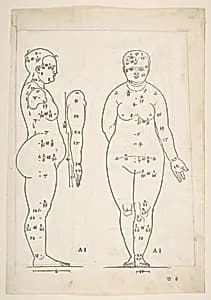
Illustration from Dürers Vier Bucher von Menslicher Proportion, Nuremberg, 1528
1528
Medium
Woodcut
Classification
Prints
Department
Drawings and Prints
Museum
Metropolitan Museum of Art, New York, NY
Credit
Bequest of James Clark McGuire, 1930
Accession Number
31.54.107
Rights
Public Domain
Tags
Art Historical Context
Albrecht Dürer’s woodcut from his 1528 treatise *Four Books on Human Proportion* exemplifies the Renaissance pursuit of ideal beauty through mathematical precision. Published in Nuremberg the year of the artist’s death, the volume presents a systematic study of human anatomy, with this illustration focusing on the female nude. Dürer sought to codify harmonious proportions, blending Northern European attention to detail with ideas drawn from Italian theory. As a woodcut, the image could be reproduced in multiple editions, allowing Dürer’s findings to reach artists and scholars across Europe. The clean lines and measured contours demonstrate his mastery of the medium, turning scientific observation into an elegant visual language. Visitors today can appreciate how such prints helped elevate the status of drawing and printmaking as intellectual pursuits equal to painting. This work reflects the era’s growing interest in humanism and empirical study, inviting viewers to consider the body as both a natural form and a constructed ideal.
About the Artist
Albrecht Dürer · 1471–1528
Albrecht Dürer (1471–1528) stands as the preeminent figure of the Northern Renaissance and arguably the most influential artist in the history of printmaking. Born in Nuremberg on May 21, 1471, and dying in the same city on April 6, 1528, Dürer revolutionized the status of the artist in Northern Europe, transforming printmaking from a commercial craft into an independent fine art and establishing ...