
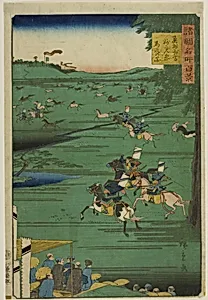
Image of the Horse Chase at the Myoken Festival, Soma, Oshu Province (Oshu Soma Myoken matsuri umao no zu) from the series “One Hundred Famous Views in the Various Provinces (Shokoku meisho hyakkei)”
Medium
Color woodblock print
Classification
woodblock print
Department
Arts of Asia
Museum
Art Institute of Chicago
Accession Number
196752
Rights
Public Domain
Art Historical Context
Behold the dynamic energy of *Image of the Horse Chase at the My Festival, Soma,shu Province* (1859), a vibrant color woodblock print by Uawa Hiroshige IIShigenobu), part of his acclaimed series *One Hundred Famous in the Various Provinces (Shokoku meisho hyakkei)*. work captures a thrilling moment from the Myoken Festival in what is now Fukushima Prefecture, where daring riders chase horses through the streets in a centuries-old ritual honoring Myoken, the North Star deity revered for protection and good fortune. Hiroshige II, a pupil and adopted son of the legendary Utagawa Hiroshige, masterfully continues the ukiyo-e tradition of depicting everyday life and landscapes with poetic realism. Printed during Japan's late Edo period, just before the Meiji Restoration, the artwork showcases the technical brilliance of woodblock printing—intricate carving and layering of color blocks to achieve rich blues, reds, and golds that evoke the festival's chaos and excitement. Horses rear wildly amid cheering crowds under a vast sky, blending human drama with natural splendor, a hallmark of Hiroshige's landscape legacy. This print not only preserves a vibrant cultural tradition but also highlights ukiyo-e's role in democratizing art through affordable multiples, bringing provincial spectacles to urban audiences in 19th-century Japan. Now housed in the Art Institute of Chicago's Arts of Asia department, it invites us to feel the pulse of Edo-era festivities and the artistry that immortalized them.
About the Artist
Utagawa Hiroshige II (Shigenobu) · 1826–1869
Utagawa Hiroshige II, born Suzuki Chinpei in 1826, was one of the most accomplished ukiyo-e artists of mid-nineteenth century Japan. He entered the studio of the celebrated landscape master Utagawa Hiroshige I — known for his iconic series "The Fifty-three Stations of the Tokaido" — and proved himself the most talented of the elder artist's few students. So highly regarded was the young pupil that...