
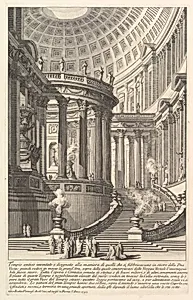
Imaginery ancient temple designed in the style of those built in honor of the Goddess Vesta... (Tempio antico inventato e disegnato alla maniera di quelli che si fabbricavano in onore della Dea Vesta...), from "Prima Parte di Architettura, e Prospettive"
ca. 1750
Medium
Etching
Dimensions
Plate: 15 11/16 × 9 15/16 in. (39.8 × 25.3 cm) Sheet: 19 7/16 × 13 1/4 in. (49.4 × 33.6 cm)
Classification
Prints
Department
Drawings and Prints
Museum
Metropolitan Museum of Art, New York, NY
Credit
Harris Brisbane Dick Fund, 1937
Accession Number
37.45.3(11)
Rights
Public Domain
Tags
Art Historical Context
Step into the visionary world of Giovanni Battista Pir with this captivating etching, *Imaginary Ancient Temple Designed in the Style of Those Built in Honor of the Goddess Vesta*, from his 1750 publication *Prima Parte di Architettura, e Prospettive*. Created around 1750, this print exemplifies Piranesi's passion for Roman antiquity during the Enlightenment era, when Europe's elite embarked on Grand Tours to rediscover classical ruins. As a leading figure in 18th-century veduta—topographical views—Piranesi blended meticulous observation with imaginative flair, evoking the grandeur of ancient Rome. The artwork depicts a fictional circular temple inspired by the real Temple of Vesta, the Roman goddess of the hearth and home, known for its distinctive round design symbolizing eternal fire. Piranesi's etching technique shines here: fine, intricate lines capture weathered stone textures, soaring columns, and dramatic foreshortening, drawing viewers into an illusory depth on a modest plate measuring 15 11/16 × 9 15/16 inches. His masterful use of light and shadow heightens the sense of sublime mystery, blurring the line between reality and fantasy. Housed in the Metropolitan Museum of Art's Drawings and Prints department, this piece underscores Piranesi's influence on Neoclassicism and Romanticism, inspiring architects like John Soane. It invites us to ponder how one artist's etchings preserved—and reimagined—the splendor of lost empires for modern eyes.
About the Artist
Giovanni Battista Piranesi · 1720–1778
Giovanni Battista Piranesi (1720–1778) was an Italian printmaker, architect, and antiquarian whose visionary etchings of Rome and imaginary prisons revolutionized architectural representation and profoundly influenced both Neoclassicism and Romanticism. Piranesi stands as one of the most important printmakers of the eighteenth century, fundamentally shaping European perceptions of ancient Rome an...