
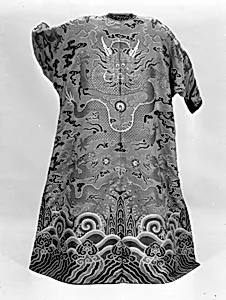
Imperial Court Robe
Unknown Artist
Medium
Silk, metallic thread
Dimensions
57 x 36 in. (144.78 x 91.44 cm)
Classification
Costumes-Woven
Culture & Period
China · Qing dynasty (1644–1911), Kangxi period (1662–1722)
Department
Asian Art
Museum
Metropolitan Museum of Art, New York, NY
Credit
Purchase, Joseph Pulitzer Bequest, 1935
Accession Number
35.84.13
Rights
Public Domain
Tags
Art Historical Context
Step into the opulent world of China's Qing dynasty with this magnificent *Imperial Court Robe*, during the Kangxi period (1662–2). The Kangxi's reign marked a golden age of cultural flourishing and artistic refinement, and robes like this were reserved for the highest echelons of imperial society—emperors, empresses, or top officials. Woven from luxurious silk and shimmering metallic threads, this garment (measuring 57 x 36 inches) exemplifies the era's sartorial splendor, where clothing was not just attire but a profound statement of power and hierarchy. The robe's design likely features majestic dragons, a motif symbolizing imperial authority, strength, and divine mandate in Chinese cosmology—the five-clawed dragon was exclusively imperial. Artisans employed intricate weaving and embroidery techniques with gold and silver threads, creating a luminous, textured surface that caught the light in grand palace halls. This fusion of materials highlighted technical mastery and the court's wealth, as silk production and metallic embellishment were state-controlled luxuries. Today, at the Metropolitan Museum of Art (acquired via the Joseph Pulitzer Bequest in 1935), this robe invites us to ponder the Qing court's rigid etiquette and aesthetic ideals. A testament to anonymous craftsmanship, it bridges fashion, politics, and artistry in Asian textile history.