
Incense Boat
Unknown Artist
1250–70
Medium
Champlevé enamel, copper-gilt
Dimensions
Overall: 3 1/16 x 10 3/8 x 4 in. (7.7 x 26.4 x 10.2 cm)
Classification
Enamels-Champlevé
Culture
French
Department
Medieval Art
Museum
Metropolitan Museum of Art, New York, NY
Credit
Gift of J. Pierpont Morgan, 1917
Accession Number
17.190.126
Rights
Public Domain
Art Historical Context
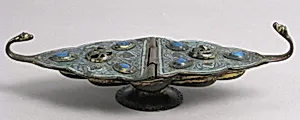
This exquisite *Incense Boat*, crafted France around 1250–70, is a masterful example of medieval liturgical art. Shaped like a small vessel—measuring just 3 1/16 x 10 3/8 x 4 inches—it held aromatic incense grains used during Catholic Masses. Suspended from chains (now missing), it supplied a swinging thurible, allowing priests to perfume the air as a symbol of prayers ascending to heaven. Housed in the Metropolitan Museum of Art's Medieval department, it was generously gifted by J. Pierpont Morgan in 1917. The object's brilliance comes from champlevé enamel on a copper-gilt base, a technique perfected in 13th-century France, particularly Limoges workshops. Artisans carved troughs into the metal, filled them with powdered glass enamels in vibrant blues, reds, and whites, then fired it to fuse the colors permanently. Gilding added a golden glow, evoking divine radiance. This labor-intensive method produced durable, jewel-like objects affordable for churches beyond royal patronage. As a snapshot of Gothic-era devotion, the *Incense Boat* highlights enamel's role in everyday worship, blending technical innovation with spiritual symbolism. Its survival offers a tactile link to the sensory world of medieval cathedrals, where sight, scent, and ritual intertwined.