
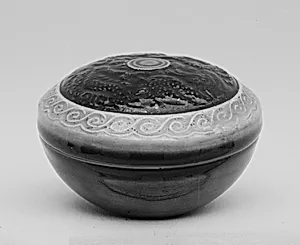
Incense Box
1800
Medium
Clay covered inside with a transparent crackled glaze and outside with polychrome glazes (Kyoto ware)
Dimensions
H. 2 1/2 in. (6.4 cm); Diam. 1 3/4 in. (4.4 cm)
Classification
Ceramics
Culture & Period
Japan · Edo period (1615–1868)
Department
Asian Art
Museum
Metropolitan Museum of Art, New York, NY
Credit
Gift of Charles Stewart Smith, 1893
Accession Number
93.3.381a, b
Art Historical Context
This exquisite incense box, created by Eiraku Hozen in 1800 during Japan’s Edo period, exemplifies the refined artistry of Kyoto ware ceramics. Hozen, a master potter from a distinguished lineage, worked in Kyoto, where he helped elevate everyday functional objects into sophisticated works of art. The small, measuring just over two inches tall, was designed for storing incense, a practice deeply tied to tea ceremonies and Buddhist rituals that flourished in the peaceful Edo era. Its technical mastery lies in the contrast of glazes: a transparent, crackled interior that highlights the clay’s n...
About the Artist
Eiraku Hozen · 1795–1854
Eiraku Hozen (1795–1854) was a celebrated Japanese ceramic artist and the sixteenth-generation head of the Nishimura family, a Kyoto dynasty of potters whose work was closely associated with the tastes of the imperial court and the refined aesthetic culture of the ancient capital. Operating under the artistic name Eiraku — a name that would become synonymous with a particular style of elegant, tec...