
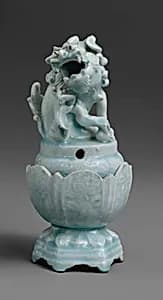
Incense Burner in Shape of Lion (one of a pair)
Unknown Artist
early 14th century
Medium
Porcelain with brown and raised decoration under celadon glaze (Jingdezhen Qingbai ware)
Dimensions
H. 8 3/4 in. (22.2 cm)
Classification
Ceramics
Culture & Period
China · Yuan dynasty (1271–1368)
Department
Asian Art
Museum
Metropolitan Museum of Art, New York, NY
Credit
Fletcher Fund, 1934
Accession Number
34.113.2a, b
Rights
Public Domain
Tags
Art Historical Context
This exquisite incense burner, shaped as a majestic lion and one of a pair,ails from China's Yuan dynasty (1271–1368), the early 14th. Crafted in Jingdezhen Qingbai ware—a renowned porcelain type from the imperial kilns—this piece stands 8¾ inches tall. Its celadon glaze, evoking the subtle green of jade, covers brown and raised decorations that add tactile depth, highlighting the lion's muscular form, fierce expression, and intricate mane. As visitors to the Metropolitan Museum of Art's Asian Art department can appreciate, such ceramics exemplify the era's technical mastery. During the Yuan period, under Mongol rule, Jingdezhen emerged as the world's porcelain capital, producing translucent wares prized for export along the Silk Road. Qingbai porcelain, with its pale, bluish-white body and elegant celadon glaze, represented a pinnacle of subtlety and refinement, bridging Song dynasty traditions with bolder Yuan innovations. The lion motif carried profound cultural weight: in Chinese lore, lions symbolized power, protection, and imperial might, often guarding temples, palaces, and homes. Incense burners like this released fragrant smoke through the beast's mouth during rituals, blending utility with symbolism. Acquired through the Fletcher Fund in 1934, this artifact invites us to ponder the fusion of artistry and spirituality in medieval China, where everyday objects became emblems of cosmic harmony.