
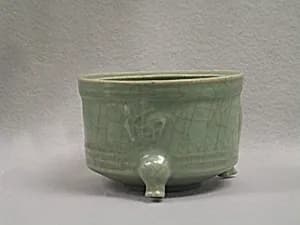
Incense burner with characters "longevity, mountain, fortune, sea" (shou shan fu hai)
Unknown Artist
13th century
Medium
Stoneware with celadon glaze (Longquan ware)
Dimensions
H. 3 3/4 in. (9.5 cm); Diam. 51/2 in. (14 cm)
Classification
Ceramics
Culture & Period
China · Southern Song dynasty (1127–1279)
Department
Asian Art
Museum
Metropolitan Museum of Art, New York, NY
Credit
Gift of Mrs. Samuel T. Peters, 1926
Accession Number
26.292.78
Rights
Public Domain
Art Historical Context
This exquisite incense burner, crafted in the 13th century China's Southern Song dynasty (112–1279), exemplifies refined artistry of Longquan ware. Produced at kilns in Zhejiang province, this small stoneware vessel—standing just 3¾ inches tall with a 5½-inch diameter—features a lustrous celadon glaze that mimics the subtle green translucency of jade, a material revered in Chinese culture for its purity and immortality. The burner's subtle, elegant form reflects the Song era's aesthetic shift toward understated elegance amid political upheaval, as the dynasty relocated south following northern invasions. Inscribed with the auspicious characters *shou* (longevity), *shan* (mountain), *fu* (fortune), and *hai* (sea), it embodies wishes for enduring life like steadfast mountains and boundless prosperity like the ocean. Such motifs were popular in scholarly and elite circles, where incense burners served both practical ritual purposes—releasing fragrant smoke during meditation or ceremonies—and as symbols of refined taste. Longquan celadons, prized for their even crackle glaze and iron-rich body, were exported across Asia, influencing ceramics in Korea and Japan. Today, this gift to the Metropolitan Museum of Art in 1926 invites visitors to appreciate the Southern Song's ceramic mastery, where everyday objects became vessels of profound cultural aspiration.