
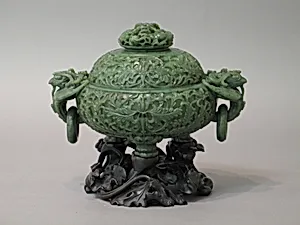
清中期 玉雙耳活環鼎爐|Incense burner with cover
Unknown Artist
18th–19th century
Medium
Jade (nephrite)
Dimensions
H. 5 9/16 in. (14.1 cm); W. 8 5/8 in. (21.9 cm); D. 6 5/16 in. (16 cm)
Classification
Jade
Culture & Period
China · Qing dynasty (1644–1911)
Department
Asian Art
Museum
Metropolitan Museum of Art, New York, NY
Credit
Gift of Heber R. Bishop, 1902
Accession Number
02.18.665a, b
Rights
Public Domain
Art Historical Context
This exquisite jade incense burner, crafted during the mid-Qing dynasty (18th–19th century), exemplifies the pinnacle of Chinese jade carving. Fashioned from nephrite jade—a tough, translucent green stone revered in China for its purity and symbolic ties to immortality—the vessel takes the traditional form of a *dinglu* (tripod censer) with a domed cover, two arched ears fitted with loose rings, and a sturdy three-legged base. Measuring just 5 9/16 inches tall, its compact size (H. 14.1 cm; W. 21.9 cm; D. 16 cm) made it ideal for scholarly studios, ancestral altars, or Buddhist rituals, where fragrant incense smoke wafted through the pierced cover to invoke tranquility and spiritual harmony. In Qing China, jade objects like this reached artistic heights under imperial patronage, with master carvers employing fine tools to hollow the interior and incise subtle motifs, preserving the stone's natural luster. Nephrite's rarity and labor-intensive working process underscored its status as a luxury good, often gifted among elites or used in domestic worship. This burner reflects the era's blend of archaism—echoing ancient bronze ritual vessels—and refined elegance, highlighting jade's enduring cultural role as a bridge between heaven and earth. A gift to the Metropolitan Museum of Art from collector Heber R. Bishop in 1902, it invites visitors to appreciate the tactile beauty and serene presence of Qing craftsmanship, evoking the aromatic serenity of imperial gardens long past.