
Indian Weather Vane
1935/1942
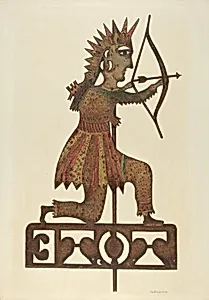
Medium
watercolor, graphite, and pen and ink on paperboard
Dimensions
overall: 57.1 x 40.2 cm (22 1/2 x 15 13/16 in.) Original IAD Object: 51" high; 31" wide
Classification
Index of American Design
Department
CG-W
Museum
National Gallery of Art, Washington, D.C.
Credit
Index of American Design
Accession Number
1943.8.16728
Rights
Public Domain
Art Historical Context
Behold the *Indian Weather Vane*, captivating rendering by artist Nicholas Amantea created between 1935 and 1942 as part of the Index of Design (IAD). ambitious Federal Art Project, launched during the Great Depression under the Works Progress Administration, employed artists across the U.S. meticulously document everyday American folk art objects through precise watercolor illustrations. Amantea’s work captures a historic weather vane—originally 51 inches high and 31 inches widelikely featuring a Native American figure, a popular motif in 19th-century American vernacular sculpture that symbolized frontier spirit and whimsy. Executed in watercolor, graphite, and pen and ink on paperboard (measuring 57.1 x 40.2 cm), the piece showcases the IAD’s signature technique: hyper-detailed realism that blends scientific accuracy with artistic flair. Graphite sketches provide underlying structure, while pen and ink add crisp outlines, and watercolor infuses vibrant color, preserving the vane’s weathered patina and dynamic form for posterity. Housed in the National Gallery of Art’s collection, it highlights how folk objects like weather vanes—functional yet fanciful—reflected regional craftsmanship and cultural identity. This artwork not only revives a slice of Americana but also underscores the IAD’s role in elevating folk art to national treasure status, ensuring these humble icons endure for future generations.
About the Artist
Nicholas Amantea · 1900–1978
Nicholas Amantea (1900–1978) was an American artist born on July 13, 1900, in Pittsburgh, Pennsylvania. His early life and artistic training are not well documented, but by the mid-1930s, he had established himself in New York City, where he contributed significantly to federal art initiatives during the Great Depression. From March 13, 1936, to July 15, 1942, Amantea worked for the Works Progress...