
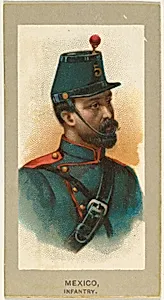
Infantry, Mexico, from the Military Uniforms series (T182) issued by Abdul Cigarettes
1881
Medium
Commercial color lithograph
Dimensions
Sheet: 3 3/16 × 1 3/4 in. (8.1 × 4.4 cm)
Classification
Prints|Ephemera
Department
Drawings and Prints
Museum
Metropolitan Museum of Art, New York, NY
Credit
The Jefferson R. Burdick Collection, Gift of Jefferson R. Burdick
Accession Number
63.350.246.182.24
Rights
Public Domain
Tags
Art Historical Context
Step into the vibrant world of 19th-century ephemera with *Infantry, Mexico*, a gem from the Military Uniforms series (T) issued by Abdul Cig in 1881. This petite commercial color lithograph, measuring just 3 /16 × 1 3/4 inches, captures the distinctive uniform of Mexican infantry soldiers in detail. Part of a popular set distributed inside cigarette packs, it reflects the era's fascination with global militaries and imperial pageantry, offering collectors a window into international dress and discipline. Cigarette cards like this one were ingenious marketing tools, transforming everyday smokes into treasures that educated and entertained. Produced during a boom in chromolithography—a revolutionary printing technique that allowed mass production of colorful, multi-layered images—these cards turned advertising into accessible art. Abdul Cigarettes' series highlighted uniforms from around the world, fueling armchair adventures amid Europe's colonial rivalries and Mexico's own turbulent post-independence history. Today, housed in The Metropolitan Museum of Art's Drawings and Prints department as part of The Jefferson R. Burdick Collection, this print underscores the cultural role of "trade cards" in preserving everyday history. A tiny testament to commerce and curiosity, it invites us to appreciate how even a soldier's sash could spark wonder.
About the Artist
Abdul Cigarettes · 1881–1881
Abdul Cigarettes, an enigmatic American entity active solely in 1881, stands as a fascinating footnote in the history of commercial art, best known for producing vibrant chromolithograph trade cards inserted into cigarette packages as promotional inserts. Little is documented about its origins or personnel, suggesting it operated as a short-lived publishing venture rather than the work of a singul...