
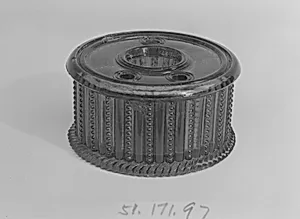
Inkwell
Unknown Artist
1800–1900
Medium
Lacy pressed blue glass
Dimensions
H. 1 7/8 in. (4.8 cm); Diam. 3 1/2 in. (8.9 cm)
Classification
Inkwell
Department
The American Wing
Museum
Metropolitan Museum of Art, New York, NY
Credit
Gift of Mrs. Charles W. Green, in memory of Dr. Charles W. Green, 1951
Accession Number
51.171.97
Rights
Public Domain
Art Historical Context
This delicate inkwell, crafted from lacy pressed blue glass between 1800 and 1900, exemplifies the ingenuity of 19th-century American glassmaking Standing just 1 7/8 inches tall with a 3 1/2-inch diameter, its petite form was designed for practical use on a writing desk, holding ink for quills during an era when letter-writing was a daily ritual. The "lacy" effect comes from a pioneering pressed glass technique, where molten glass forced into finely detailed molds, creating intricate, net-like patterns that mimicked expensive cut glass—at a fraction of the cost. This innovation, popularized by factories like those in New England, made elegant household goods accessible to the growing middle class. Housed in The Metropolitan Museum of Art's American Wing, this anonymous artwork highlights the democratic spirit of American decorative arts. During the Industrial Revolution, such objects bridged handmade luxury and machine production, reflecting cultural shifts toward mass manufacturing without sacrificing beauty. Its vibrant blue hue adds a touch of whimsy, evoking the optimism of the Victorian age. Gifted in 1951 by Mrs. Charles W. Green in memory of her husband, Dr. Charles W. Green, the inkwell invites us to ponder the quiet stories of everyday life preserved in glass—a testament to America's inventive craftsmanship.