
Inname en plundering van een stad door Franse troepen
1795 - in or before 1841
Medium
etching
Dimensions
134; 183
Rights
Public Domain
About this artwork
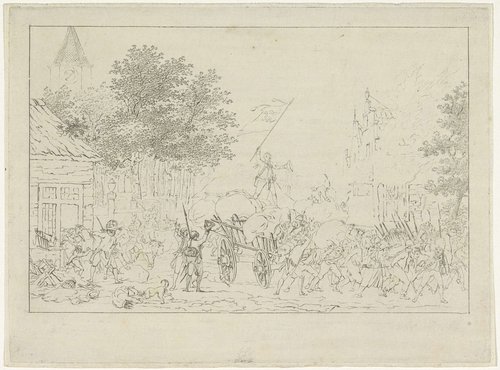
Franse troepen trekken een Nederlandse stad binnen. Op een hooiwagen die door Nederlanders moet worden getrokken, staat een Franse soldaat met een vlag. Links trekt een soldaat een vrouw aan haar haren uit haar huis.
Art Historical Context
**Inname en plundering van stad door Franse troepen** (Entry and Plundering of a by French Troops) is a poignant etching by Dutch artist Joannes Bemme created in 1795 or shortly before 1. Measuring a compact 134 mm high by 183 mm wide, this print captures a dramatic moment of invasion: French troops march into a Dutch city, one soldier atop a hay wagon pulled by reluctant Dutch civilians, brandishing a flag. To the left, a harrowing scene unfolds as another soldier drags a woman by her hair from her home, symbolizing the chaos and brutality of occupation. Historically, the artwork reflects the French Revolutionary armies' invasion of the Dutch Republic in early 1795, which ended the old stadtholder regime and birthed the Batavian Republic under French influence. Bemme's etching likely served as visual commentary on the resentment felt by many Dutch citizens toward the French "liberators," who imposed heavy requisitions and military drafts. Such scenes were common in contemporary prints, fueling patriotic sentiments amid the turmoil of the Revolutionary Wars. As an etching, Bemme's technique—using acid to incise lines into a metal plate—allowed for detailed, reproducible imagery that could spread quickly through pamphlets and broadsheets. This medium was ideal for capturing raw emotion and topical events, making the print not just art, but a cultural artifact of Dutch resistance and memory during a transformative era. Visitors, imagine the tension in those etched lines— a snapshot of history's human cost.