
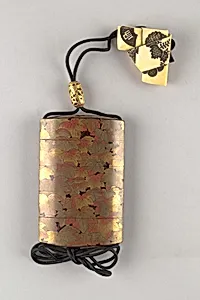
秋蔦蒔絵印籠|Inrō with Autumn Ivy
early 19th century
Medium
Four cases; lacquered wood with gold, silver, and color (iroko) togidashimaki-e on black lacquer ground Netsuke: ivory; folded letter decorated with paulownia and Genji incense symbols Ojime: oblong bead; gilt bronze with openwork design of autumn flowers
Dimensions
3 11/16 x 2 3/8 x 3/4 in. (9.3 x 6 x 1.9 cm)
Classification
Inrō
Culture & Period
Japan · Edo period (1615–1868)
Department
Asian Art
Museum
Metropolitan Museum of Art, New York, NY
Credit
H. O. Havemeyer Collection, Bequest of Mrs. H. O. Havemeyer, 1929
Accession Number
29.100.877
Rights
Public Domain
Tags
Art Historical Context
Behold the exquisite *Inrō with Autumn* by Koma Kyūhaku VI, a master lacquer artist from the renowned Koma family during Japan's Edo period (1615–1868). Crafted in the early 19th, this four-case inrō—dimensions a compact 3 11/16 x 2 3/8 x 3/4 in.—was a fashionable accessory for samurai and merchants. Hung from silk cords on the obi sash, it held medicines, seals, or tobacco, secured by an ojime bead and netsuke toggle, showcasing the era's blend of utility and opulent artistry. The black lacquer ground bursts with autumn ivy leaves in *togidashimaki-e*, a sophisticated technique where gold, silver, and colored powders (*iroko*) are meticulously sprinkled, layered, and burnished to reveal shimmering designs. The ivory netsuke depicts a folded letter adorned with paulownia crests and Genji incense symbols—evoking courtly romance—while the gilt bronze ojime features openwork autumn flowers, harmonizing seasonal motifs. This reflects Edo Japan's obsession with nature's fleeting beauty and *wabi-sabi* impermanence. Part of the H.O. Havemeyer Collection at the Metropolitan Museum of Art, this inrō exemplifies peak lacquerware innovation, a craft demanding years of apprenticeship. Visitors, imagine slipping it onto your sash: a portable poem of fall's elegance!