
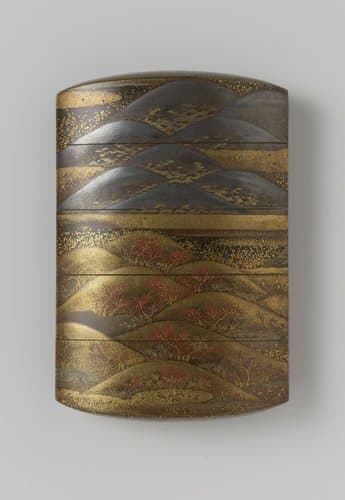
Inro with hilly landscape
c. 1800 - c. 1850
Medium
wood (plant material)
Dimensions
6; 1.5; 8.5
Rights
Public Domain
About this artwork
Bruikleen van de Koninklijke Vereniging van Vrienden der Aziatische Kunst (legaat Westendorp-Osieck, 1968)
Art Historical Context
### Inro with Hilly LandscapeCrafted by Nishikawa Yasunobu around 1800–1850 Japan's Edo period, this delicate *inro* (a compact stacking case) exemplifies the exquisite craftsmanship of traditional Japanese accessories. Measuring just 8.5 cm high, 6 cm wide, and 1.5 cm deep, it was designed to hang from a kimono sash via a cord and netsuke toggle, serving as a portable container for medicines, seals, or tobacco. The artist's rendition of a hilly landscape captures the serene beauty of nature, a favored motif in Edo-era art that evoked the tranquility of rural Japan. Made from wood—a plant-based material prized for its workability—this *inro* highlights the period's mastery of organic mediums. While many *inro* featured lacquer, Yasunobu's use of wood underscores the versatility of natural materials in creating intimate, wearable art. The compact form demanded precision, turning everyday utility into a canvas for subtle scenic depictions. On loan from the Koninklijke Vereniging van Vrienden der Aziatische Kunst (via the 1968 Westendorp-Osieck bequest), this piece reflects the global appreciation for Edo-period artifacts. *Inro* like this were status symbols for samurai and merchants, blending functionality with aesthetic refinement and preserving a glimpse of pre-modern Japanese culture.