
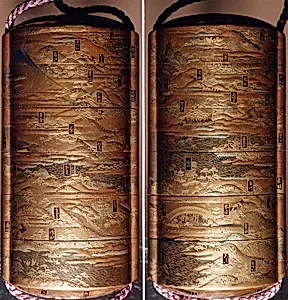
東海道五十三次蒔絵印籠|Inrō with the “Fifty-three Stations of the Tōkaidō”
Unknown Artist
19th century
Medium
Five cases; lacquered wood with gold and silver takamaki-e, hiramaki-e, togidashimaki-e, cut-out gold foil on gold and nashiji ground Netsuke: carved wood; Kintarō beating a Tengu Ojime: gold bead with stag in relief
Dimensions
3 13/16 x 1 7/8 x 1 1/8 in. (9.7 x 4.7 x 2.8 cm)
Classification
Inrō
Culture & Period
Japan · Edo period (1615–1868)
Department
Asian Art
Museum
Metropolitan Museum of Art, New York, NY
Credit
The Sylmaris Collection, Gift of George Coe Graves, 1931
Accession Number
31.49.12
Rights
Public Domain
Tags
Art Historical Context
This exquisite *Inrō with the “Fifty-three Stations the Tōkaidō”* is a masterpiece of Edo-period (1615–1868) Japanese lacquerware, in the 19th century by an artist. An *inrō* was a portable medicine case worn suspended from the belt by samurai, merchants, and elites via a silk cord. Comprising five stacked lacquered wood cases (3 13/16 x 1 7/8 x 1 1/8 in.), it the era's fascination with ukiyo-e prints, particularly Hiroshige's iconic series depicting the 53 post stations along the vital Tōkaidō road from Edo (Tokyo) to Kyoto. The landscapes of mountains and stations evoke travel, nature, and the transient beauty of life. The surface dazzles with advanced *makie* techniques: gold and silver *takamaki-e* (raised sprinkled lacquer), *hiramaki-e* (flat sprinkled), *togidashimaki-e* (burnished for subtle sheen), and cut-out gold foil over shimmering *nashiji* (pear-skin) grounds. These methods, perfected over centuries, create depth, texture, and luminous landscapes that seem to shift with light—hallmarks of Japanese lacquer artistry's technical virtuosity and aesthetic refinement. Completing the ensemble are a carved wood *netsuke* of the strong boy Kintarō wrestling a mythical Tengu goblin, symbolizing youthful vigor, and a gold *ojime* bead slide with a stag in relief, adding playful folklore and natural motifs. Donated to the Metropolitan Museum of Art in 1931, this *inrō* captures Edo Japan's blend of functionality, artistry, and cultural storytelling.