
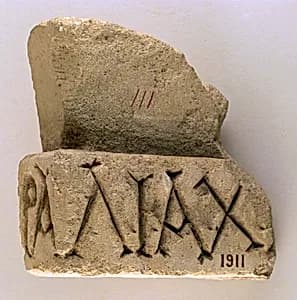
Inscribed limestone base
Unknown Artist
2nd–3rd century CE
Medium
Limestone
Dimensions
H.: 4 1/8 x 4 1/2 x 1 5/8 in. (10.5 x 11.4 x 4.1 cm)
Classification
Cesnola Inscriptions
Culture & Period
Roman, Cypriot · Imperial
Department
Greek and Roman Art
Museum
Metropolitan Museum of Art, New York, NY
Credit
The Cesnola Collection, Purchased by subscription, 1874–76
Accession Number
74.51.2440
Rights
Public Domain
Art Historical Context
This modest inscribed limestone base, dating to the 2nd–3rd century, hails from Roman Cyprus during the Imperial period Crafted from durable local limestone—a material prized for its workability longevity in the Mediterranean—the small (just over 4 inches tall likely served as a plinth for a statue, altar, or votive offering. Such bases were commonplace in Cypriot sanctuaries and public spaces, bearing inscriptions that recorded dedications, honors, or memorials in Greek, the lingua franca of the eastern Roman Empire. Its cultural significance lies in illuminating everyday Roman life on Cyprus, an island rich in Greco-Roman heritage and a key hub for trade and worship. Inscriptions like this one offer glimpses into personal piety, civic pride, or imperial loyalty, preserving voices from antiquity that might otherwise be lost. As part of the Cesnola Collection—assembled by explorer Luigi Palma di Cesnola and acquired by the Metropolitan Museum of Art in the 1870s—this piece underscores Cyprus's blend of Hellenistic traditions with Roman innovation. Though the exact text remains a tantalizing mystery without further detail, artifacts like this remind us how even humble stones anchored the spiritual and social fabric of ancient societies, inviting us to ponder the stories etched in time.