
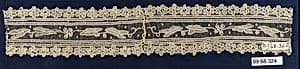
Insertion
Unknown Artist
19th century
Medium
Needle lace, Point de Gaze
Dimensions
L. 10 1/2 x W. 1 3/4 inches 26.7 x 4.4 cm
Classification
Textiles-Laces
Culture
Belgian, Brussels
Department
European Sculpture and Decorative Arts
Museum
Metropolitan Museum of Art, New York, NY
Credit
Purchase by subscription, 1909
Accession Number
09.68.324
Rights
Public Domain
Art Historical Context
Behold the delicate "Insertion," a exquisite example of 19th-century needle lace from Brussels, crafted in the renowned Point de Gaze technique. just 10½ by 1¾ inches, this strip was designed for insertion into garments—think elegant collars, cuffs, or dress edges—adding a whisper of opulence to Victorian fashion. Point de G, meaning "gaze" or "gauze point," mimics the ethereal lightness of fine fabric through intricate needlework: artisans stitched cotton or linen threads directly onto a paper pattern, creating a misty, veil-like texture without bobbins. Brussels lace dominated the 19th-century market, with Point de Gaze emerging around the 1850s as a luxurious innovation that blended tradition with innovation. Produced in workshops by skilled lacemakers, often women, it symbolized Belgium's cultural prestige in decorative arts, exported worldwide to adorn royalty and the elite. This piece, acquired by The Metropolitan Museum of Art in 1909 through public subscription, highlights the era's fusion of craftsmanship and commerce. Today, it invites us to marvel at the patience behind each tiny stitch—a testament to lace's role in elevating everyday textiles into wearable art, preserving Brussels' legacy in the Textile-Laces collection of European Sculpture and Decorative Arts.