
Insertion
Unknown Artist
early 17th century
Medium
Needle lace, punto in aria
Dimensions
L. 13 1/2 x W. 2 1/2 inches 34.3 x 6.4 cm
Classification
Textiles-Laces
Culture
Italian
Department
European Sculpture and Decorative Arts
Museum
Metropolitan Museum of Art, New York, NY
Credit
Rogers Fund, 1920
Accession Number
20.186.345
Rights
Public Domain
Art Historical Context
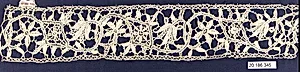
**Insertion**, a masterful example of early 17th-century Italian needle lace, showcases the pinnacle of *punto in aria*—a revolutionary technique meaning "point in air." Created without a supporting fabric, this method allowed skilled artisans, likely from Venice, to stitch intricate, free-floating patterns directly in space using a single needle and thread. Measuring a slender 13½ × 2½ inches (34.3 × 6.4 cm), the lace features delicate floral motifs and scrolling designs, embodying the era's obsession with elegance and refinement. In Baroque Europe, such insertions were prized luxury items, seamlessly woven into garments like collars, cuffs, or bodices to elevate fashion among the nobility. Italian lace, especially Venetian, dominated the market, symbolizing wealth and sophistication while supporting a thriving industry of female lacemakers. This piece highlights the technical virtuosity of anonymous craftspeople whose innovations influenced decorative arts across continents. Today, housed in the Metropolitan Museum of Art's European Sculpture and Decorative Arts department (acquired via the Rogers Fund in 1920), *Insertion* invites us to marvel at lace's transformation from functional trim to high art—fragile yet enduring threads of history.