
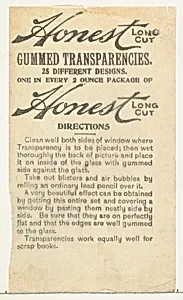
Instruction insert from the Transparencies series (N137) issued by W. Duke, Sons & Co. to promote Honest Long Cut Tobacco
late 1880s
Medium
Commercial color lithograph
Dimensions
Sheet: 4 3/16 × 2 1/2 in. (10.6 × 6.4 cm)
Classification
Prints|Ephemera
Department
Drawings and Prints
Museum
Metropolitan Museum of Art, New York, NY
Credit
The Jefferson R. Burdick Collection, Gift of Jefferson R. Burdick
Accession Number
63.350.207.137.25
Rights
Public Domain
Art Historical Context
Step into the vibrant world of 19th-century advertising with this petite *Instruction insert from the Transparencies seriesN137)*, produced by W. Duke, Sons &. in the late 1880s. Issued to promote their "Honest Long Cut Tobacco this commercial color lithograph served as a clever insert, likely tucked into tobacco packages. Measuring just 4 3/16 × 2 1/2 inches, it exemplifies the era's innovative ephemera—disposable yet collectible items designed to captivate consumers. Chromolithography, the medium here, brought vivid colors and sharp details to mass-produced prints, revolutionizing commercial art. Duke's series tapped into the novelty of "transparencies," thin sheets meant to be held against light for glowing, lantern-like effects, turning everyday tobacco into an interactive experience. This reflects the tobacco industry's pioneering marketing, where companies like Duke flooded the market with branded inserts to foster loyalty amid fierce competition. Housed in the Metropolitan Museum of Art's Jefferson R. Burdick Collection—a treasure trove of American prints and ephemera—this piece highlights how everyday commerce fueled artistic innovation, blending utility, whimsy, and bold promotion in Gilded Age America.
About the Artist
W. Duke, Sons & Co. · 1870–1920
**W. Duke, Sons & Co.: Pioneers of Chromolithographic Trade Card Art** W. Duke, Sons & Co., an American tobacco manufacturer, emerged from the entrepreneurial vision of Washington Duke (1820–1905) and his sons in Durham, North Carolina. After the Civil War, Washington abandoned farming in 1874 to join his eldest son, Brodie L. Duke, in the burgeoning tobacco trade, establishing a factory that for...