
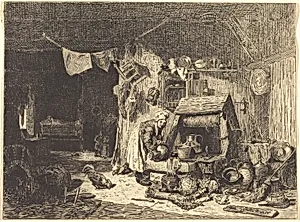
Interior of a Farmhouse
1833
Medium
etching
Classification
Department
CG-E
Museum
National Gallery of Art, Washington, D.C.
Credit
Gift of Elsie F. Alsberg
Accession Number
1977.52.2
Rights
Public Domain
Art Historical Context
Jules Dupré’s 1833 etching “Interior of a Farmhouse” offers a quiet glimpse into rural domestic life in early nineteenth-century France. Working in the intimate medium of etching, Dupré used fine lines and subtle tonal contrasts to record the modest furnishings, wooden beams, and everyday objects that defined farmhouse interiors of the period. The print’s small scale and reproducible nature made such scenes available beyond the walls of private collections, inviting broader audiences to consider the dignity of ordinary spaces. As a print gifted to the National Gallery of Art by Elsie F. Alsberg, the work now forms part of a public collection that preserves the artist’s early explorations of light and texture. The etching technique, with its capacity for delicate detail, allowed Dupré to emphasize both the solidity of simple architecture and the soft play of shadows across surfaces. Visitors can appreciate how this modest print captures a moment of stillness, connecting modern viewers to the textures and rhythms of rural existence nearly two centuries ago.
About the Artist
Jules Dupré · 1811–1889
Jules Dupré (1811–1889) was born in Nantes, France, on April 5, the son of a porcelain manufacturer. He began his artistic career in his father's factory before moving to paint porcelain at his uncle's china factory in Sèvres. Lacking formal training or a specific teacher, Dupré debuted at the Paris Salon in 1831, earning a second-class medal three years later. A pivotal trip to England in 1834 ex...