
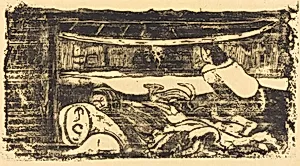
Interior of a Hut (Interieur de case)
in or after 1895
Medium
woodcut in black
Classification
Department
CG-E
Museum
National Gallery of Art, Washington, D.C.
Credit
Rosenwald Collection
Accession Number
1955.16.1
Rights
Public Domain
Art Historical Context
Step into the evocative world of Paul Gaug's *Interior of a Hut (Inter de case)*, a striking woodcut created in or after 1895. During this period, Gauguin was immersed in his second stay in Tahiti, where he sought to capture the raw essence of Polynesian life, far from European conventions. This black-ink print, housed in the National Gallery of's Rosenwald Collection, the simple, shadowy confines of a traditional Tahitian dwelling, reflecting his fascination with indigenous culture and escape from Western industrialization. Gauguin, a Post-Impressionist pioneer and champion of Primitivism, revolutionized printmaking with this bold woodcut technique. Carved directly into wood blocks, his prints feature rough, incisive lines and flattened forms, mimicking the directness of Oceanic art while evoking a sense of mystery and intimacy. Unlike refined European engravings, Gauguin's approach was deliberately crude, emphasizing texture and emotional depth over precision. This work exemplifies Gauguin's Noa Noa series, where he shared his idealized visions of paradise through affordable prints. It invites viewers to ponder the artist's romanticized gaze on colonial encounters, blending exotic allure with profound cultural commentary—a timeless window into his revolutionary spirit.
About the Artist
Paul Gauguin · 1848–1903
Paul Gauguin (1848-1903) was a French Post-Impressionist painter whose bold experiments with color, form, and subject matter made him one of the most influential figures in the transition from 19th-century art to modernism. His rejection of European civilization for the perceived authenticity of 'primitive' cultures established an archetype of artistic exile that continues to resonate. Gauguin's ...