
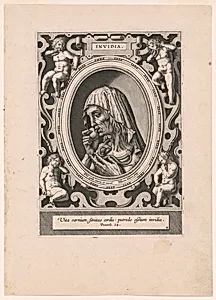
Invidia, plate 4 from The Seven Vices
c. 1598
Medium
Engraving on paper
Dimensions
Plate: 18.6 × 13.3 cm (7 3/8 × 5 1/4 in.); sheet: 26.2 × 19.5 cm (10 3/8 × 7 11/16 in.)
Classification
engraving
Department
Prints and Drawings
Museum
Art Institute of Chicago
Accession Number
271111
Rights
Public Domain
Art Historical Context
**Invidia, plate 4 from The Seven Vices *Hieronymus Wierix (Netherlandish, 1553–1619), c. 1598* Engraving on paper Plate: 18.6 × 13.3 cm Step into the intricate world of late 16th-century moral allegory with *Invidia*, the fourth plate in Hieronymus Wierix's *The Seven Vices*. Created around 1598, this small yet powerful engraving personifies Envy (Invidia), one of the deadly sins, capturing her tormented expression amid symbolic tormentors. Wierix, a master engraver from a renowned Flemish family of printmakers, specialized in finely detailed reproductive prints that brought elaborate designs to life, often drawing from Northern Renaissance and Mannerist influences. Engravings like this were revolutionary for their time, allowing widespread dissemination of religious and ethical teachings during the Counter-Reformation era in the Spanish Netherlands. Printed on modest paper sheets (here, 26.2 × 19.5 cm), these works were affordable collectibles for devout households, serving as visual sermons against vice. Wierix's technique—precise lines etched into copper plates—yields extraordinary depth and texture in miniature scale, making the emotional intensity of Envy's pale, anguished face leap off the page. Housed in the Art Institute of Chicago's Prints and Drawings Department, *Invidia* exemplifies how printmaking democratized art, blending artistry with moral instruction. Visitors, imagine pinning this to your wall as a Renaissance reminder: envy devours the soul!