
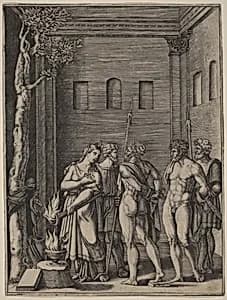
Iphigenia Recognizing Her Brother
1401 to 1500
Medium
engraving
Classification
Department
CG-E
Museum
National Gallery of Art, Washington, D.C.
Credit
Andrew W. Mellon Fund
Accession Number
1976.20.3
Rights
Public Domain
Art Historical Context
In the National Gallery of Art's collection, *Iphigenia Recognizing Her Brother* a captivating engraving by Agostino deii, a masterful Italian printmaker active during the late 15th century. work, dated between 1401 and 1500, depicts a poignant moment from ancient Greek mythology, drawn from Euripides' *Iphigenia inis*. Here, Iphigenia, believed sacrificed years earlier, reunites with her-lost brother Orest in a scene brimming with emotion and dramatic revelation—a favorite theme in Renaissance art for exploring human drama and fate. Engraving, the medium of this print, was revolutionary in the Renaissance, allowing artists like Musi to incise intricate lines into copper plates for multiple impressions. This technique enabled the widespread dissemination of sophisticated imagery, bridging classical antiquity with early modern audiences. Musi's precise burin work captures expressive figures and dynamic compositions, reflecting the era's revival of antique stories through innovative printmaking. Acquired through the Andrew W. Mellon Fund and housed in the CG-E department, this piece highlights the cultural bridge between myth and Renaissance ingenuity. Visitors will appreciate how such prints democratized high art, making epic tales accessible beyond elite patrons. A testament to Musi's skill, it invites us to ponder recognition's profound joy amid tragedy.