
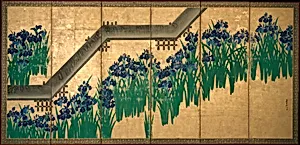
八橋図屏風 |Irises at Yatsuhashi (Eight Bridges)
after 1709
Medium
Pair of six-panel folding screens; ink and color on gold leaf on paper
Dimensions
Image (each screen): 64 7/16 in. x 11ft. 6 3/4 in. (163.7 x 352.4 cm) Overall (each screen): 70 1/2 in. x 12 ft. 2 1/4 in. (179.1 x 371.5 cm)
Classification
Paintings
Culture & Period
Japan · Edo period (1615–1868)
Department
Asian Art
Museum
Metropolitan Museum of Art, New York, NY
Credit
Purchase, Louisa Eldridge McBurney Gift, 1953
Accession Number
53.7.1, .2
Rights
Public Domain
Tags
Art Historical Context
Ogata Kōrin’s *Irises at Yatsuhashi (Eight Bridges)* is a celebrated pair of six-panel folding screens created after 1709 during Japan’s Edo period. As a master of the Rinpa school, Kōrin specialized in bold, decorative compositions that blend nature and elegance. The screens depict stylized clusters of irises in full bloom, arranged in rhythmic patterns across shimmering gold-leaf backgrounds, evoking a famous scene from the classical literary work *Tales of Ise*. The medium—ink and color on gold leaf on paper—highlights the luxurious aesthetic prized in Japanese screen painting. Gold leaf not only provides a radiant, reflective surface that shifts with light but also flattens space, emphasizing the flowing lines of the flowers and the implied bridges suggested by the title. This technique creates a sense of depth while maintaining a decorative harmony typical of Rinpa works. Housed in the Metropolitan Museum of Art’s Asian Art collection, the screens exemplify Kōrin’s ability to transform literary and natural motifs into timeless visual poetry, inviting viewers to appreciate both the beauty of the irises and the refined artistry of early 18th-century Japan.
About the Artist
Ogata Kōrin · 1658–1716
Noted as one of the most important Japanese artists of the 17th century; known for paintings of irises and other subjects. He was regarded, along with Sotatsu, as one of the masters of the Sotatsu-Koetsu school of decorative painting, including painted screens and textile designs. He was descended from a samurai who had served under the Ashikaga rulers.