
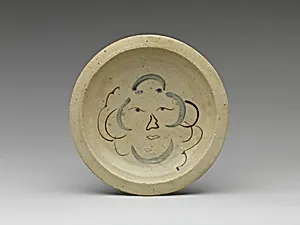
Ishizara Plate with Design of Human Face
Unknown Artist
mid-18th–early 19th century
Medium
Stoneware (Seto ware)
Dimensions
H. 2 in. (5.1 cm); Diam. 10 1/2 in. (26.7 cm)
Classification
Ceramics
Culture & Period
Japan · Edo period (1615–1868)
Department
Asian Art
Museum
Metropolitan Museum of Art, New York, NY
Credit
The Harry G. C. Packard Collection of Asian Art, Gift of Harry G. C. Packard, and Purchase, Fletcher, Rogers, Harris Brisbane Dick, and Louis V. Bell Funds, Joseph Pulitzer Bequest, and The Annenberg Fund Inc. Gift, 1975
Accession Number
1975.268.604
Rights
Public Domain
Tags
Art Historical Context
This delightful *Ishizara Plate with Design of Human Face*, in stoneware from the Seto kilns during Japan's Edo period (mid-18th to 19th century), the era's blend of functionality and whimsy. Measuring just 2 inches high and 10½ inches in diameter, this shallow dish—likely used for serving food or as a decorative tray—boasts a textured surface mimicking natural stone, a hallmark of *ishizara* (stone plate) style. central human face motif, boldly rendered, adds a playful anthropomorphic touch rare in everyday ceramics. Seto ware, originating from the ancient kilns in Aichi Prefecture, was prized for its durable stoneware bodies coated in ash glazes that produced earthy, variegated tones. One of Japan's Six Ancient Kilns, Seto production flourished in the prosperous Edo era, when urban culture thrived and potters innovated for both domestic use and aesthetic appeal. This piece reflects that accessibility, bridging utilitarian craft with artistic expression. Housed in the Metropolitan Museum of Art's Asian Art Department as part of the Harry G. C. Packard Collection, the plate invites visitors to ponder Edo Japan's lighthearted creativity—where even a simple dish could wear a face, evoking smiles across centuries.