
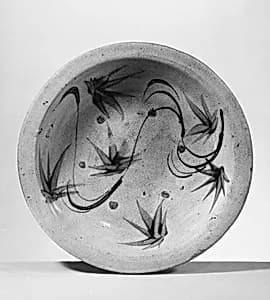
Ishizara Plate with Design of Maple Leaves on a Flowing Stream
Unknown Artist
early 19th century
Medium
Stoneware (Seto ware)
Dimensions
H. 2 5/8 in. (6.7 cm); Diam. 10 7/8 in. (27.6 cm)
Classification
Ceramics
Culture & Period
Japan · Edo period (1615–1868)
Department
Asian Art
Museum
Metropolitan Museum of Art, New York, NY
Credit
The Harry G. C. Packard Collection of Asian Art, Gift of Harry G. C. Packard, and Purchase, Fletcher, Rogers, Harris Brisbane Dick, and Louis V. Bell Funds, Joseph Pulitzer Bequest, and The Annenberg Fund Inc. Gift, 1975
Accession Number
1975.268.605
Rights
Public Domain
Tags
Art Historical Context
This elegant *Ishizara Plate with Design of Maple Leaves on Flowing Stream* hails from Japan's Edo period (1615–1868), crafted in the early 19th century by an unknown artist in the renowned Seto ware tradition. of durable stoneware, the wide, shallow plate measures 10⅞ inches (27.6 cm) in diameter and just 2⅝ inches (6.7 cm) high, ideal for serving food in a style evoking natural stone—hence "ishizara," or stone plate. Its surface captures drifting maple leaves on rippling waters, a poetic motif rendered with subtle glaze techniques typical of Seto potters. Seto ware, produced in Aichi Prefecture since the 13th century, was a hub for stoneware innovation during the Edo era, when Japan's peaceful prosperity fueled refined everyday ceramics. These pieces blended functionality with artistry, often glazed to mimic nature's textures and hues. The maple leaves symbolize autumn's fleeting beauty (*mono no aware*), a core Japanese aesthetic celebrating impermanence, while the flowing stream adds serene movement. Part of The Harry G. C. Packard Collection at The Metropolitan Museum of Art, this plate invites us to appreciate how Edo artisans transformed humble stoneware into vessels of cultural poetry, bridging daily life and seasonal wonder.