
Island in the Tiber, Rome
Medium
etching
Dimensions
plate: 17.1 x 23.1 cm (6 3/4 x 9 1/8 in.)
Classification
Department
CG-W
Museum
National Gallery of Art, Washington, D.C.
Credit
Rosenwald Collection
Accession Number
1943.3.7490
Rights
Public Domain
Art Historical Context
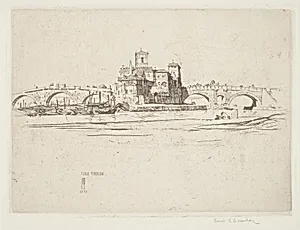
Louis Conrad Rosenberg's *Island in the Tiber,* (1921) captures the timeless allure of Isola Tiberina, a, boat-shaped island in Rome's River steeped in ancient history. Once the site of a temple to Aesculapius, god of medicine, it now hosts the Fatebenefratelli Hospital. Rosenberg, an American etcher renowned for his meticulous depictions of European architecture, renders the island's bridges, buildings, and shimmering water with exquisite precision, evoking the Eternal City's layered past during the post-World War I era when artists flocked to Italy for inspiration. This etching, measuring 17.1 x 23.1 cm, exemplifies Rosenberg's mastery of the intaglio technique. He incised fine lines into a metal plate, which acid etched to create rich tonal contrasts and intricate details—hallmarks of early 20th-century printmaking. Etchings like this allowed for affordable multiples of high-art quality, bridging fine art and accessibility. Housed in the National Gallery of Art's Rosenwald Collection, the print highlights Rosenberg's contribution to preserving architectural heritage through graphic arts. Visitors will appreciate its delicate balance of shadow and light, inviting a serene reflection on Rome's enduring romance.
About the Artist
Louis Conrad Rosenberg · 1890–1983
Louis Conrad Rosenberg (1890–1983), born in Portland, Oregon, to Charles and Hannah Rosenberg, emerged as one of America's foremost architectural etchers, blending his training as an architect with masterful printmaking. A precocious draftsman from childhood, he apprenticed under T. Chapell Brown in Portland starting at age sixteen in 1906, advancing to draftsman under mentor Ellis Fuller Lawrence...