
Isotta Atti, vierde vrouw van Sigismondo Pandolfo Malatesta, heer van Rimini
1800 - 1900
Medium
casting
Dimensions
8.1; 2158
Rights
Public Domain
About this artwork
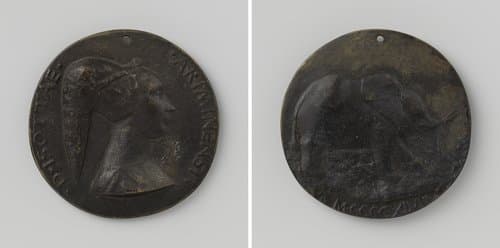
Bronzen penning met gat. Voorzijde: borststuk vrouw met puntmuts binnen omschrift. Keerzijde: olifant boven opschrift.
Art Historical Context
This bronze medal, cast between 1800 and 1900 after an original design by the fifteenth-century Italian artist Matteo di Andrea de’ Pasti, portrays Isotta Atti, the fourth wife of Sigismondo Pandolfo Malatesta, lord of Rimini. The obverse shows her bust wearing a distinctive pointed headdress within a Latin inscription, while the reverse features an elephant—the Malatesta family emblem—above further text. A small hole indicates the piece was likely intended to be worn or displayed. Medals like this one played an important role in Renaissance court culture, serving as portable portraits that celebrated political alliances and personal devotion. De’ Pasti worked closely with the Malatesta family, producing works that blended classical motifs with contemporary portraiture to project power and refinement. Although this example is a later casting, it preserves the elegant profile style and symbolic imagery of the original fifteenth-century medals. Such objects offer modern viewers a tangible connection to the artistic patronage that flourished in Renaissance Italy.