
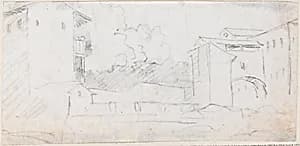
Italian City Scene
probably c. 1754/1765
Medium
black chalk on laid paper
Dimensions
Overall: 7.1 x 14.8 cm (2 13/16 x 5 13/16 in.) support: 15.6 x 21.5 cm (6 1/8 x 8 7/16 in.)
Classification
Drawing
Department
CG-E
Museum
National Gallery of Art, Washington, D.C.
Credit
Julius S. Held Collection, Ailsa Mellon Bruce Fund
Accession Number
1984.3.42
Rights
Public Domain
Art Historical Context
Hubert Robert, the acclaimed 18th-century French artist often called "Robert des Ruines," captured the allure of Italy in this intimate drawing, *Italian City Scene*, likely created around 1754–1765 during or just after his formative years in Rome. A Prix de Rome winner, Robert immersed himself in the Eternal City's ancient architecture and vibrant urban life from 1755 to 1764, influences that shaped his lifelong fascination with picturesque ruins and imagined landscapes. This small-scale sketch evokes the grandeur of Italian piazzas and palazzos, blending observation with artistic fancy in the spirit of Neoclassicism's romantic vein. Executed in black chalk on laid paper—a favored medium for its subtle tonal range and portability—this 7.1 x 14.8 cm gem showcases Robert's masterful draftsmanship. Black chalk allowed him to achieve soft shadows and atmospheric depth, rendering architectural details with fluid precision typical of his preparatory studies. Though modest in size, it exemplifies how such drawings served as vital touchstones for larger paintings, preserving fleeting impressions of Italy's cultural splendor amid the Enlightenment's growing appreciation for antiquity. Housed in the National Gallery of Art's Julius S. Held Collection (Ailsa Mellon Bruce Fund), this work invites visitors to ponder Robert's enduring legacy: transforming sketches into portals of 18th-century wanderlust and historical reverie.
About the Artist
Hubert Robert · 1733–1808
Hubert Robert, born on May 22, 1733, in Paris, emerged from a modest background; his father, Nicolas Robert, served the influential Choiseul family, whose patronage shaped the young artist's path. After completing his studies at the Jesuit Collège de Navarre in 1751, he entered the atelier of sculptor Michel-Ange Slodtz, who taught him design and perspective before encouraging a shift to painting....