
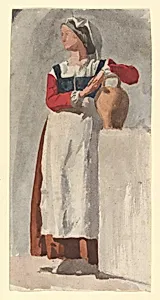
Italian Woman
ca. 1856–57
Medium
Graphite and watercolor on laid paper
Dimensions
sheet: 8 1/4 x 4 1/8 in. (21 x 10.5 cm)
Classification
Drawings
Department
Drawings and Prints
Museum
Metropolitan Museum of Art, New York, NY
Credit
The Walter H. and Leonore Annenberg Collection, Bequest of Walter H. Annenberg, 2002
Accession Number
2003.20.5
Rights
Public Domain
Tags
Art Historical Context
In the mid-1850s, a young Edgar Degas, in his early twenties, created *Italian Woman*, a intimate graphite and watercolor study on laid paper measuring just 8¼ × 4⅛ inches. This early work captures the artist during his formative years in Italy, where he immersed himself in the region's art and people after leaving his Paris studio. Degas, influenced by academic masters like Ingres, his precocious talent for portraiture through swift, expressive lines and subtle watercolor washes that evoke the subject's thoughtful gaze and draped attire. The drawing's modest scale and mixed media highlight Degas's experimental approach to capturing life from observation, a hallmark of his evolving style before his later Impressionist fame with ballet scenes. Laid paper, with its textured chains and wires, was a favored support for such spontaneous sketches, lending an authentic, handmade quality. Housed in the Metropolitan Museum of Art's Drawings and Prints department as part of the Annenberg Collection, this piece offers a glimpse into Degas's early fascination with women as subjects, blending realism with emerging modernity. Though small, *Italian Woman* reveals the meticulous observation that would define Degas's career, inviting visitors to appreciate the quiet poetry in everyday portraiture.
About the Artist
Edgar Degas · 1834–1917
Edgar Degas (1834-1917) stands as one of the most innovative artists of the nineteenth century, whose distinctive vision transformed how modern life could be depicted on canvas. Born Hilaire-Germain-Edgar De Gas in Paris to a wealthy banking family—his father French, his mother a Louisiana Creole from New Orleans—Degas received a classical education before abandoning law studies in 1855 to pursue ...