
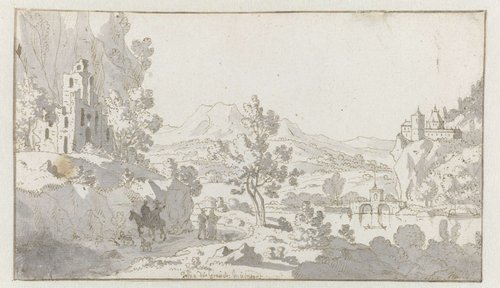
Italianiserend rivierlandschap met reizigers in de buurt van ruïnes
in of na ca. 1667 - 1712
Medium
pen and brown ink, with grey wash, over traces of graphite; framing line in brown ink
Dimensions
164; 95
Rights
Public Domain
About this artwork
Gift of M.L. van Hoorn, Amsterdam, H.C. van Hoorn, Amsterdam, and P.H.F. van Hoorn, Amsterdam
Art Historical Context
Behold *Italianiserend rivierlands met reizigers in de van ruïnes* by Josua de Grave, delicate Dutch drawing from around 1667–1712 that captures the allure of an idealized Italian landscape. Rendered on a modest scale (95 × 164 mm), it depicts a serene river scene with travelers pausing near ancient ruins, ev the romantic grandeur of classical antiquity. De Grave, a lesser-known but skilled draughtsman active in the late Dutch Golden Age, embraced the "Italianate" style—popular among Northern artists—who infused their works with the sunlit vistas and pastoral charm of Rome's countryside, even if created from imagination or studies. Executed in pen and brown ink with grey wash over faint graphite traces, and framed by a subtle brown ink line, this piece showcases virtuoso techniques of the period. The precise ink lines define forms with fluid energy, while the grey wash adds atmospheric depth, mimicking light and shadow on water and foliage. Such mixed-media drawings were prized as autonomous works or preparatory sketches, highlighting the era's mastery of paper as a canvas for landscape innovation. Generously gifted by the Van Hoorn family of Amsterdam, this artwork reflects the enduring Dutch fascination with Italy's cultural legacy amid their own prosperous Republic. It invites visitors to ponder how 18th-century artists bridged Northern realism with Southern fantasy, offering a window into travel dreams and timeless ruins.
About the Artist
Josua de Grave · 1643–1712
Comment on works: Landscapes; Views